
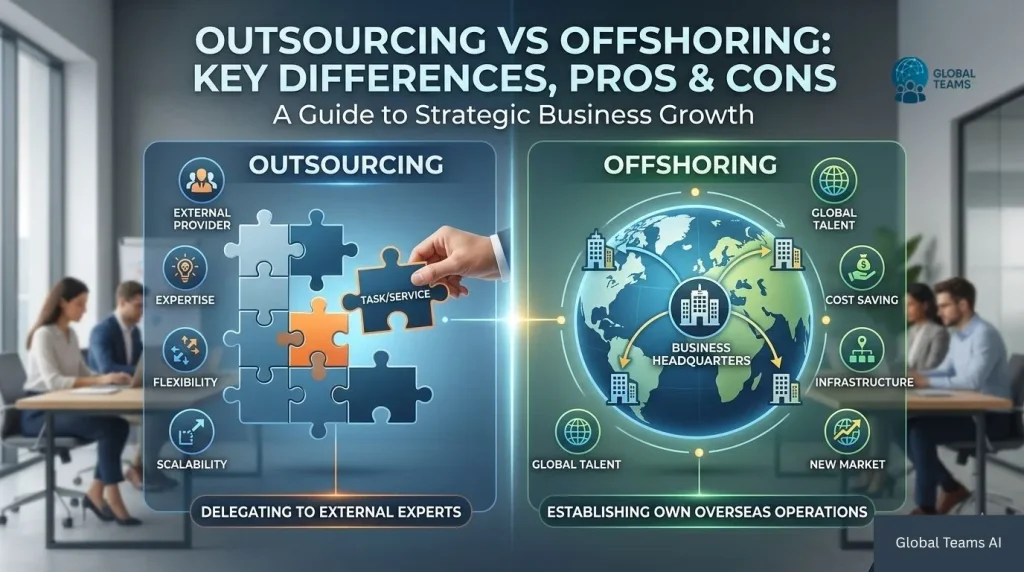
Given the present trends in businesses, firms are constantly seeking ways to cut costs, streamline their operations, and outperform other firms. They have adopted different practices, such as outsourcing vs offshoring. Despite what people believe about both terms being the same, there are slight differences between the two.
Knowing the difference between outsourcing and offshoring may help business owners make well-informed decisions about operations, staffing, and growth. You will be taught about the exact definition of outsourcing vs offshoring, the differences, examples, benefits, and drawbacks of outsourcing and offshoring.
If you are a businessman, digital marketer, or content writer, this guide will help you understand the difference between offshoring and outsourcing.
Main Highlights
- Outsourcing vs offshoring are completely different ways for businesses; outsourcing is about using external service providers, whereas offshoring means moving operations to another country.
- Outsourcing can assist businesses in saving costs, gaining access to professional workers, and quick scaling, which makes it perfect for start-ups and growing businesses.
- Offshoring can facilitate business development through cost-saving in labor and expanding globally, particularly for those that aim to launch major operations.
- Offshoring vs outsourcing examples include customer service outsourcing, bookkeeping outsourcing, AI intern support, and offshoring of web development, which will allow you to see real-world application scenarios.
- When deciding whether to go with outsourcing or offshoring, you need to consider several factors, including goals, budget, etc., with many organizations utilizing both strategies simultaneously.
Outsourcing Vs Offshoring Definition
The distinction between outsourcing and offshoring definitions is the key to selecting the best approach for your business. Although both outsourcing and offshoring can be effective means of increasing efficiency and cutting costs for a company, they differ from each other.
What is Outsourcing?
Outsourcing involves engaging an outside firm or person to carry out certain operations or services in place of doing such work in-house. Organizations use outsourcing for the purpose of saving time, cutting down costs, and obtaining the required expertise without recruiting permanent staff members.
Outsourcing services can take place within the country or overseas, based on the need and feasibility of the firm.
Popular Outsourcing Services
The following are some of the common outsourced business functions:
- Customer support services
- Online marketing and SEO optimization services
- Content writing and copywriting
- Accounting and bookkeeping services
- IT support and technical services
- Website development and design services
- Virtual assistant services
Get multiple outsourcing services with Global Teams AI at an affordable cost without worrying about quality compromise.
Features of Outsourcing
Outsourcing usually entails the following aspects:
- Delegation of operations to outside service providers
- Involves cost savings and efficiency improvement
- Occurs domestically or internationally
- Facilitates the availability of skilled services
In short, outsourcing is all about delegating some business activities to outside experts in lieu of doing such work in-house.
What is Offshoring?
Offshoring is defined as the process of moving business operations or activities to another nation. Businesses opt for offshoring in order to gain advantages such as reduced labor costs, better regulatory frameworks, or access to high-quality talent.
Offshoring differs from outsourcing, whereby businesses usually set up their own structures or teams abroad.
Typical Offshoring Tasks
The following are some typical tasks that businesses outsource:
- Manufacturing and production processes
- Software development departments
- Call centers and customer service departments
- Data processing and data entry departments
- Back-office processes
Characteristics of Offshoring
Some of the common characteristics of offshoring include:
- Moving operations or business activities abroad
- Setting up organizational infrastructure or teams abroad
- Aiming at achieving economies of scale and cost reduction
- Planning and setting up infrastructure
In summary, offshoring entails moving business operations to other countries in order to save money and increase operations.
Pros and Cons of Offshoring and Outsourcing
It is important to study the advantages and disadvantages of outsourcing and offshoring to be able to make correct decisions in business. These two strategies bring certain cost savings and other benefits, but they may cause some difficulties as well.
Through a close analysis of both strategies, it becomes clear which one to choose from among the others.
Pros of Outsourcing
There are several advantages to outsourcing for different companies, including start-ups that require growth without additional internal work.
1. Cost Efficiency
The first significant advantage of outsourcing is cost efficiency since a company can cut its costs by hiring an outside provider who will cover expenses such as:
- Staff wages
- Office rent
- Technology investments
- Education and training
For instance, outsourcing customer service and accounting enables a business to pay only for the services required and not maintain a dedicated department.
2. Expertise Availability
Another advantage of outsourcing is that businesses will be able to employ highly trained professionals worldwide. Therefore, instead of investing months recruiting and educating employees, firms will have quick access to experienced specialists.
This strategy may be particularly useful in performing specific tasks, including:
- Online advertising initiatives
- Coding programs
- Search engine optimization
- Creative designs
- Financial advice and legal consulting
3. Improved Efficiency and Productivity
Service providers generally have expertise in certain fields. Therefore, they can accomplish tasks faster and more efficiently compared to in-house staff that has general skills.
For instance:
- IT service providers can address technical problems quickly
- Expert writers can produce content consistently
- Virtual assistants can simplify daily tasks
Efficiency plays a key role in meeting deadlines and boosting customer satisfaction.
4. Flexibility and Scalability
Businesses can adjust their activities using outsourcing since they can change the amount of work according to their needs and demands.
Flexibility is useful because it helps businesses:
- Cope with sudden expansion
- Prepare for busy times
- Save money when demand is low
- Respond to market changes
- It makes outsourcing suitable for businesses that intend to expand.
5. Concentration on Key Business Operations
Through outsourcing, businesses can focus on other important tasks instead of concentrating on everyday chores.
For example:
- Businesses can outsource payroll management
- Marketing departments can outsource content writing
- IT firms can outsource support services
It gives leaders time to think about their business strategies and operations.
Cons of Outsourcing
Despite the benefits, there are downsides to outsourcing that must be weighed by organizations prior to the process.
1. Difficulty in Communication
Communication difficulties will arise from collaboration with third-party workers or teams situated in other regions with different time zones.
Such communication problems are:
- Response delays
- Misperception of language
- Cultural diversions
- Interpretation of instructions
For the effective management of communication, businesses need to rely on documentation and meetings and utilize reliable communication methods.
2. Poor Quality Management
Quality management may prove to be a tough task with an outsourced task performed by someone who works independently of your business environment.
This happens when the instructions are not clear, and deadlines are approaching, but there are no quality control measures. The risk is higher in cases of:
- Incomplete instructions
- Urgent deadlines
- Lack of quality criteria
Firms should set up quality control measures
3. Security and Confidentiality Risks
The act of outsourcing may entail disclosing confidential information about the business, its clients, or its finances with third-party contractors.
This could lead to:
- Data leakage
- Breaches of confidentiality
- Information hacking
In order to mitigate potential risks, businesses must:
- Utilize secure methods of data transfer
- Draft confidentiality agreements
- Check the security measures of vendors
4. Hidden Costs
Although outsourcing may result in reduced expenses, unforeseen costs could come into play in situations where there is:
- Amendments to contracts
- Unforeseen charges for services
- Fluctuations in exchange rates
- Vendor oversight fees
Outsourcing Vs Offshoring Examples
Outsourcing vs offshoring examples from the real world can be useful in comprehending how they function. It is easy to learn about the practical applications of both processes when reviewing typical business operations such as customer support services, accounting, artificial intelligence assistance, and website development.
Example 1: Outsourcing Bookkeeping Services
An expanding business outsources its bookkeeping needs, involving financial record keeping, invoicing, payroll, and tax filing to a separate firm that specializes in these functions. Rather than establish its own accounting department, the business utilizes bookkeepers, who work out of their own offices.
This is termed outsourcing, as the bookkeeping services are offered by a separate entity or third party. Through outsourcing, the firm enjoys efficient financial management and reduces administrative burden.
Example 2: Outsourcing an AI Intern
The company is a technology start-up that requires assistance with the execution of routine activities like data input, formatting of information, and preliminary research. Rather than employing people to perform the above functions, the company enters into a partnership with a third party that provides AI Interns.
In this scenario, the AI intern works as an outsourcing function through the services provided by the outsourcing agency. This way, the company benefits from the efficiency and effectiveness of these tasks being carried out while avoiding the costs associated with employing full-time personnel.
Example 3: Offshoring Web Development
An organization that produces software products chooses to open a web development department in a different country where there are talented developers who can work for competitive rates. This organization leases the office premises and employs its staff.
This is an example of offshoring whereby the firm has full ownership and control over the development group located in a foreign country. Through the offshoring of the web development functions, the firm will benefit by lowering labor costs, controlling the quality of the project, and increasing its capacity.
What is The Difference Between Offshoring and Outsourcing
Understanding the outsourcing vs offshoring difference is essential for strategic planning.
| Feature | Outsourcing | Offshoring |
| Definition | Hiring external service providers | Moving operations to another country |
| Ownership | Third-party vendor | Company-owned operations |
| Location | Domestic or international | Always international |
| Cost Structure | Service-based payments | Infrastructure investment |
| Flexibility | High | Moderate |
| Risk Level | Vendor dependency | Operational complexity |
Conclusion
Outsourcing Vs Offshoring Understanding is key to minimizing operational costs, maximizing efficiency, and staying ahead of the competition in an ever-evolving market space. While outsourcing is concerned with the hiring of outside firms to complete certain tasks, offshoring entails the relocation of a firm’s operations to another country in order to maximize cost reduction.
These two approaches have distinct benefits, but the best one will largely depend on the type of objectives and available resources your business is looking at. Outsourcing is better suited for firms aiming for flexibility and ready availability of services, while offshoring will be ideal for firms looking to conduct big-time operations.
As such, a keen consideration of the needs of your firm should precede any decision to adopt one or both of these approaches. This way, a firm can enhance its efficiency while minimizing costs, hence ensuring sustainability.
Frequently Asked Questions
1. What is outsourcing vs offshoring?
Outsourcing versus Offshoring is an expression that denotes two distinct business approaches employed for increasing efficiency and minimizing costs. Outsourcing involves entrusting certain activities to a third-party firm or individual, whereas offshoring entails relocating the activities of a business to another country to minimize costs.
To put it simply, outsourcing relates to the person performing the task, whereas offshoring relates to where the activity takes place.
2. How are outsourcing and offshoring different?
The fundamental difference between outsourcing and offshoring is that in the former case, the focus is on the relationship with external service providers, whereas in the latter case, it is on the establishment of overseas business operations.
Outsourcing may be local or offshore, but offshoring necessarily means establishing operations overseas.
3. What are the benefits of outsourcing vs offshoring?
Outsourcing as well as offshoring have multiple advantages based on the requirements of the organization. The advantage of outsourcing includes reduction in costs, acquiring talented people, and gaining flexibility. Offshoring involves reducing the cost of labor, working round-the-clock, and expanding globally.
The choice between the two depends on the needs of the business for efficiency or expansion.
4. Which is better: outsourcing or offshoring?
It cannot be said for certain that one practice is superior to the other. The choice of outsourcing or offshoring will depend on the nature of the company’s operations and its financial resources.
In many cases, small and medium-scale businesses opt for outsourcing due to lower capital requirements. Big firms might consider offshoring as a more suitable option.
5. Can outsourcing and offshoring be used together?
Indeed, several firms apply both outsourcing and offshoring in their operations. For instance, an organization can engage in offshoring by relocating its developers to a foreign country but outsource customer services to an external firm.
Through this method, firms benefit from improved efficiency and cost reduction.