
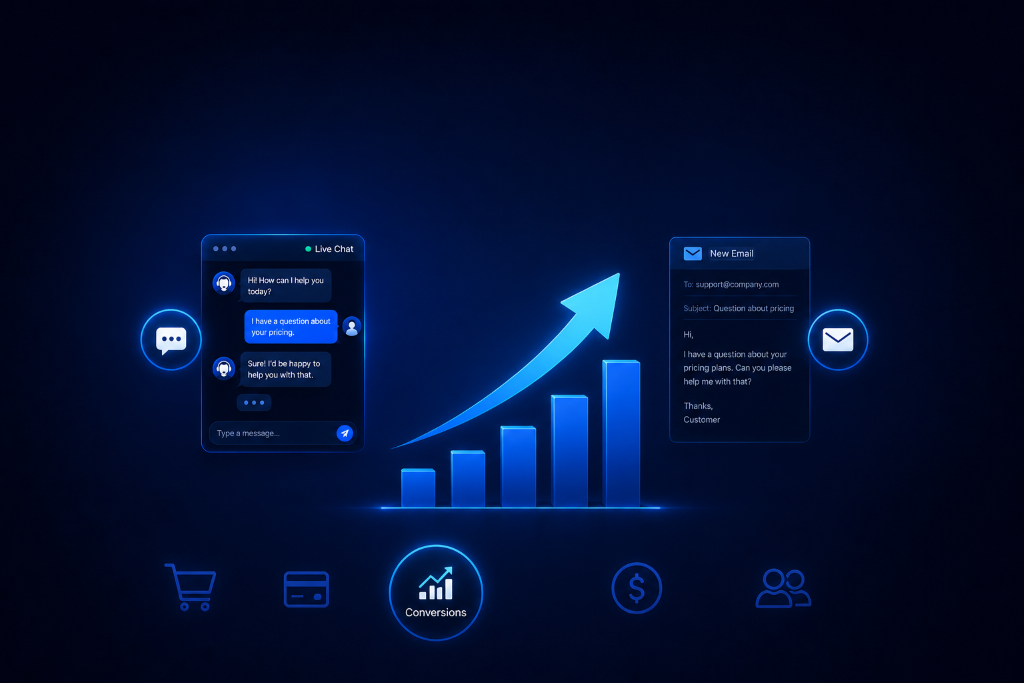
A delay in support often leads to lost opportunities. Customers prefer fast and simple communication. This brings focus to live chat vs email support.
Businesses try to improve response time but face different types of queries. Some need instant help while others need detailed explanations. This creates a gap in the support strategy.
In this blog, live chat vs email support will be explained to understand which drives better results.
Key Highlights
- Live chat provides instant replies, helping users to make quicker choices on websites.
- Email support is better for detailed explanations and dealing with more complex customers.
- The response time via live chat enhances customers’ satisfaction and decreases drop-offs.
- If you need structured communication and a record of your conversations, then email is a good option.
- Combining both channels leads to a more comprehensive customer experience and support for businesses.
What is Live Chat?
Live chat is a real-time communication service that allows customers to interact with customer service agents instantly on a website. It is used to provide instant feedback to a website visitor is still browsing. This communication channel is used to enhance interactions with business customers. It minimizes delays and provides prompt assistance when required. A live chat tool is also used by many companies to assist users during essential activities, such as checkout or product selection.
Most live chat software uses either chat agents or automated systems to manage live chat conversations. It facilitates real-time interaction, so customers don’t have to wait for lengthy email responses. This reduces response time and helps direct customers through the sales channels more quickly. It is commonly used by businesses to quickly resolve issues and help users who require immediate help while visiting the business.
When to use Live Chat?
- When customers need immediate assistance during their web browsing or app use.
- Checkout or pricing pages – where they need to respond quickly before they make a decision.
- To minimize delays and improve customer satisfaction during busy periods.
- For customers with simple questions, chat agents can resolve issues in real time.
- During business hours or with tools that allow for handling multiple conversations at once.
👋 Want to improve customer response time? Explore GTeams AI live chat services for real-time customer support solutions.
What is Email Support?
Email support is a communication approach in which the customer sends an email with a question or problem, and the support team responds later. It is used a lot of time when cases require detailed explanations or documentation. This form of asynchronous communication allows both the customer and the agent to thoroughly study the issue before responding.
With email support, businesses can handle customer inquiries during non-working hours and across time zones. It works well for things that need to be investigated, screenshots, or files attached. Many customer service teams use email to maintain organized customer communications and provide accurate solutions.
When to use Email Support?
- Problems that need a detailed explanation or checks.
- Customers can provide files, screenshots, or documents to customer service staff.
- In the case of non-urgent queries that do not require an immediate response.
- To handle requests across various time zones and out-of-business hours.
- For organized business communications to customers and record-keeping of business communications.
Live Chat vs Email Support: Key Differences
Both support channels help businesses connect with customers in different ways. Understanding the key differences helps companies choose the most appropriate choice for their support process.
| Feature | Live Chat | Email Support |
| Response Speed | Offers immediate response through real-time messaging. | Replies take longer because of asynchronous communication. |
| Customer Interaction | Helps a website visitor get fast answers during browsing. | Better for formal and detailed conversations. |
| Conversation Handling | Chat agents can support handling multiple users at the same time. | Agents usually focus on one email thread at a time. |
| Best Use Case | Good for questions requiring immediate support or buying help. | Better for technical issues and long explanations. |
| Support Experience | Often connected with social media, CRM tools, or an omnichannel inbox. | Common for structured follow-ups and records. |
Live Chat vs Email Support: Which Drives More Conversions?
When businesses compare live chat vs email support, conversions are often the biggest factor. Fast support can remove buyer hesitation and help customers make quicker decisions. This is why many brands now focus more on instant communication during the customer journey.
The debate around email support vs live chat depends on how customers interact with a business. Some users want quick answers before buying. Others prefer detailed replies after a purchase. Both channels matter, but their impact on conversions is different.
| Factor | Live Chat | Email Support |
| Conversion Speed | Helps customers make faster buying decisions. | Slower replies can delay purchase decisions. |
| Customer Interaction | Creates a more customized experience during browsing. | Better for long discussions and follow-ups. |
| Sales Support | Useful for handling questions before checkout. | More effective after the sale is completed. |
| Customer Help | Agents can guide users instantly with product details. | Teams often use a knowledge base for detailed responses. |
| Team Management | Works well with a shared inbox for faster coordination. | Good for organized customer records and tracking. |
In most cases, live chat vs email support shows that chat drives more direct sales. Fast answers often reduce confusion and improve trust during the buying process. This also helps businesses keep users engaged for a longer time.
Email support still plays an important role in customer retention and long-term communication. It works best for detailed support cases that need proper explanation or follow-up. Many businesses now combine both channels to improve sales and customer support.
Which Support Channel Do Customers Prefer?
In recent years, customer expectations have dramatically changed. Most users expect quick responses from a site. Here’s where live chat vs. email support becomes relevant for understanding behavior. This is often based on the urgency of the issue and the need for immediate assistance.
Today, many companies make live chat support their top priority due to their customers’ demands. A virtual assistant can also handle chats and direct the users during peak hours. This setup allows businesses to respond more quickly and deliver high-quality support. Meanwhile, email remains a part of the conversation for doing detailed, non-urgent communication.
- Most customers prefer live chat, which allows instant help while they are still on a website.
- Users choose chat when they need quick answers before making a purchase decision.
- Email is preferred for issues that need longer explanations or follow-up details.
- Mobile users tend to prefer chat because they find it fast and more direct.
- For formal communication and record-keeping, business users can continue to use email.
The type of issue and the speed of response can influence customer preference. Some users want instant help while others value detailed communication. Supporting both can help businesses to satisfy the needs of a variety of customers.
Conclusion
Live chat and email support are both important to the way businesses communicate with users. Depending on the situation and the customer’s expectations, the communication channel serves various purposes. Live chat is best for people who need quick help, while email is better for comprehensive, structured responses.
Generally, businesses get more conversions when they prioritize faster support. Still, combining both methods creates a balanced system for handling different customer experiences. The right setup helps improve trust, reduce wait time, and support users at every stage of their journey.
FAQs
Can both live chat and email support improve business growth?
Yes, both contribute to a better customer experience. Live chat increases conversions while email improves trust. As a whole, they can help to support long-term business growth.
Which is better for increasing conversions, live chat or email support?
Live chat usually drives more conversions. It helps customers get instant answers. This reduces drop-offs during purchase.
Can a virtual assistant help with live chat?
Yes, a virtual assistant can manage conversations and provide initial guidance. It ensures users get quick replies even during busy periods. Agents can focus on complex queries.
Can live chat handle multiple customers at the same time?
Yes, chat agents or automated systems can manage handling multiple conversations simultaneously. This improves efficiency during peak hours. Email support typically deals with one conversation per agent at a time.
What’s faster, live chat or email support?
Live chat is much faster. It provides instant responses. Whereas email support takes more time to reply.