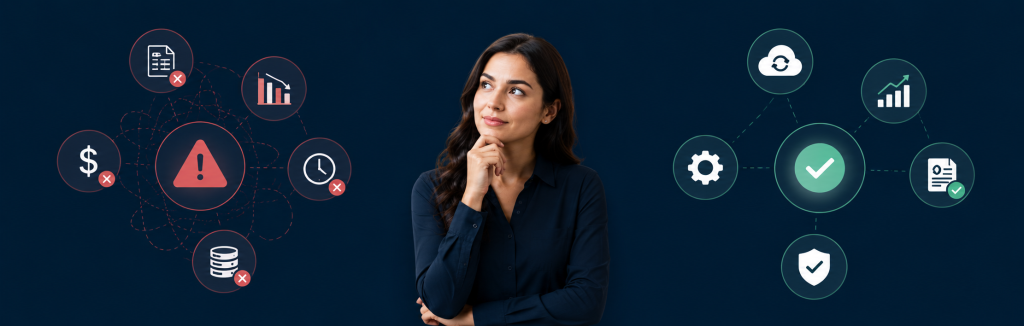

Your accounts payable team is buried. Invoices sit in inboxes for days. Month-end close keeps slipping. A vendor calls about a payment that was supposed to go out two weeks ago.
If any of that sounds familiar, you are not alone. Invoice volumes are rising, approval chains are getting longer, and finance teams are stretched thin doing work that does not require their expertise. The fix is not hiring another full-time AP clerk. It is choosing to outsource invoice processing services to a team that handles this kind of work every day.
This guide is written for finance leaders, operations managers, and business owners evaluating outsourced invoice processing for the first time or renegotiating an existing arrangement. By the end, you will know exactly what to look for, what questions to ask, what it costs, and how to get started.
Quick Summary
- Manual invoice processing costs between $10 and $22 per invoice. Outsourcing to an AI-augmented team can cut that by 50 to 80 percent.
- Best-in-class AP teams process invoices in 3.1 days versus 17.4 days for everyone else.
- This guide walks you through what to look for, what to avoid, and how to get started in under seven days.
What Is Invoice Processing Outsourcing?
Invoice processing outsourcing means handing your end-to-end accounts payable workflow to an external team. That team handles everything from the moment an invoice arrives to the moment it is posted, paid, and documented.
It is not just data entry. A capable outsourced team manages the full cycle:
- Invoice capture: Receiving invoices via email, portal, PDF, EDI, or paper scan
- Data extraction and validation: Pulling line-item data and checking it against purchase orders and receipts
- Three-way matching: Reconciling invoice, PO, and goods receipt
- Exception handling: Flagging discrepancies and routing them for resolution
- Approval routing: Getting the right sign-offs before payment
- ERP posting: Coding and posting to your accounting system (QuickBooks, NetSuite, SAP, etc.)
- Audit documentation: Maintaining a clean, compliant paper trail
The distinction from pure automation software is important. Outsourcing means dedicated people plus automation tools working together. You are not buying a SaaS subscription and hoping your team figures it out. You are offloading the entire function.
What Does the Outsourced Invoice Processing Workflow Look Like?
| Step | What Happens |
| 1. Receipt | Invoice arrives via email, portal, or scan |
| 2. Capture | Data extracted using OCR or AI parsing |
| 3. Validate | Line items checked against PO and receipt |
| 4. Match | Three-way match confirmed or exception flagged |
| 5. Approve | Routed to the right approver per your rules |
| 6. Post | Coded and posted to your ERP |
| 7. Archive | Stored with full audit trail |
5 Signs It Is Time to Outsource Invoice Processing
Not every business is ready to outsource on day one. These are the clearest indicators that your current AP setup is costing you more than an outsourced model would.
1. Your average processing time exceeds 10 days
According to Ardent Partners’ 2025 AP Benchmarking Report, best-in-class AP teams process invoices in 3.1 days. The average for everyone else is 17.4 days. If you are sitting anywhere near that average, you are losing cash flow and vendor goodwill every single month.
2. Your error rate is causing payment disputes
Manual invoice processing costs between $10.18 and $21.40 per invoice at the median, according to APQC’s 2024-2025 benchmarking cycle. A big chunk of that cost comes from downstream error correction that never shows up in the direct processing cost line.
3. Your AP team is doing data entry instead of finance work
If your team is spending the majority of their time on data extraction, chasing approvals, and filing invoices, they are not adding strategic value. That is a resource allocation problem, not a headcount problem.
4. Month-end close keeps slipping because invoices are not posted on time
Late posting creates a domino effect on your close timeline, financial reporting, and cash forecasting. AP delays ripple into cash forecasting, supplier negotiations, and close timelines in ways that are difficult to isolate in a P&L but very visible to a CFO.
5. You are scaling volume faster than you can hire
Hiring a full-time AP clerk to handle seasonal spikes is expensive and slow. Outsourcing lets you scale capacity without headcount commitments.
Key Benefits of Outsource Invoice Processing Services
Outsourcing invoice processing services comes with several benefits for businesses. Let’s understand them in more detail.
Faster Cycle Times
Best-in-class AP teams process invoices in 3.1 days versus 17.4 days for everyone else, according to Ardent Partners. That gap compounds directly into cash flow, vendor relationships, and month-end close timelines. Faster cycle times also mean you can capture early payment discounts that most manual-heavy teams miss entirely.
Lower Cost Per Invoice
Manual invoice processing costs between $10 and $22 per invoice, depending on complexity, approval layers, and exception rates. AI-augmented outsourced teams bring that cost down significantly. Best-in-class AP departments using smart automation spend $2 to $4 per invoice, according to Mosaic Corp data from mid-2025. That is a reduction of more than 80 percent compared to manual methods.
For a business processing 500 invoices per month, the math is straightforward:
| Model | Cost Per Invoice | Monthly Cost |
| Manual in-house | $15 (midpoint) | $7,500 |
| AI-augmented outsourced | $3.50 (estimate) | $1,750 |
| Monthly savings | $5,750 |
Fewer Errors and Disputes
Finance BPO improves processing speed by 29% and reduces error rates by 31%, making it one of the most quantifiably impactful outsourcing functions available. Fewer errors mean fewer vendor disputes, fewer reconciliation headaches, and cleaner audit trails.
Scalability Without Hiring
Outsourced teams absorb volume spikes without requiring you to recruit, onboard, or manage additional headcount. This is particularly valuable for businesses with seasonal invoice patterns or rapid growth.
Compliance and Audit Readiness
Reputable outsourced providers maintain structured documentation at every step. Every action is logged, timestamped, and retrievable. That matters more than ever in 2026, when vendor access, data residency, and audit responsiveness are expanding risk factors for any business sharing financial data externally.
What to Look for in an Invoice Processing Outsourcing Provider
This is the section most buyer’s guides skip. They list generic criteria without telling you what actually separates a good provider from a bad one.
AI-Augmented Workflows vs. Manual-Only Teams
The difference between a modern outsourced AP team and a legacy BPO is whether they use automation alongside their people or rely entirely on manual effort. Around 75% of AP departments now use some form of AI or automation, according to Medius. A provider that does not have automation baked into their workflow will be slower, more error-prone, and ultimately more expensive than one that does.
Ask any prospective provider: What tools do your team members use for data extraction and validation? If the answer is “we enter it manually,” walk away.
ERP Integration
Your outsourced AP team needs to post directly into your accounting system. Confirm they have native experience with your ERP before signing anything. Common systems include QuickBooks, Xero, NetSuite, SAP, Oracle, and Microsoft Dynamics. ERP integration work is frequently priced separately from the AP service fee, so ask upfront whether integration is included in the base scope or billed as a separate project fee.
Data Security and NDA Standards
Around 35% of organizations cite data security and compliance risks as key barriers to outsourcing financial services. That concern is legitimate. Your invoices contain supplier names, payment terms, banking details, and financial data you do not want exposed. At a minimum, require:
- A signed NDA before sharing any documents
- Clarity on where data is stored and who can access it
- Confirmation of compliance with applicable data protection standards
SLA Guarantees and Error Rate Accountability
Ask any provider for their written SLA commitments on cycle time, error rate, and exception handling. Then ask what the financial remedy is when those SLAs are missed. A provider that cannot answer that question clearly is one that has never been held accountable for performance.
Transparent Pricing
Pricing models for outsource invoice processing services vary significantly. Common structures include:
- Per-invoice pricing: You pay a fixed fee for each invoice processed. Best for predictable, lower-volume programs.
- Hourly model: You pay for hours worked. Works well for variable workflows or when invoice complexity varies significantly.
- Monthly retainer: Fixed monthly cost for a defined scope. Best for predictable volume where you want cost certainty.
Watch for hidden costs: exception handling fees, ERP integration charges, rush processing surcharges, and fees for additional invoice formats or currencies.
Dedicated vs. Shared Teams
A shared team means your invoices are handled by the same people handling five other clients’ invoices. A dedicated team means you have named, accountable individuals who know your workflows, your vendors, and your approval rules. For anything beyond the most basic volume, a dedicated model produces better outcomes.
Provider Comparison by Type
| Provider Type | Best For | Watch Out For |
| Legacy BPO (Genpact, EXL) | Enterprise, high-volume, multi-currency | High cost, long contracts, limited flexibility |
| Regional accounting firm | SMBs, bookkeeping-adjacent AP | Limited automation, slow scaling |
| AI-native outsourcing (e.g., gteams.ai) | SMBs and growth-stage businesses | Confirm ERP depth before committing |
| Freelance / marketplace | One-time projects, low volume | No SLA accountability, security risk |
Step by Step Process on How to Outsource Invoice Processing
Now that we are well aware of the benefits and need of invoice processing
Step 1: Audit Your Current AP Workflow and Volume
Before you can brief a provider, you need to know what you are handing over. Document your current invoice volume (per month), invoice types (PO-backed vs. non-PO), number of approval layers, your ERP system, and your current average cycle time. This takes one afternoon and makes every subsequent conversation far more productive.
Step 2: Define Your Scope
Be specific. Are you outsourcing full-cycle AP or just the data entry and coding? Will the provider handle exception resolution or escalate to you? Are there multi-currency invoices involved? Do you need the team to work your time zone hours? The more clearly you define scope upfront, the fewer surprises you encounter in month two.
Step 3: Shortlist Providers and Request Written Scope Proposals
Do not evaluate providers on a sales call alone. Request a written scope proposal that specifies exactly what is included, what is excluded, how exceptions are handled, who the point of contact is, and what the escalation path looks like. Compare written scopes, not just price, when reviewing invoice processing outsourcing options.
Step 4: Evaluate Security Protocols and Data Handling
Review the provider’s NDA, data storage policy, and team access controls before sharing any documents. Confirm data residency (where is your data physically stored?) and ask whether the team undergoes background checks.
Step 5: Run a 30-Day Pilot
Before committing to a long-term arrangement, run a defined pilot on a subset of your invoice volume. This tests the workflow in real conditions, surfaces integration issues before they become expensive, and gives you baseline KPI data.
Step 6: Set KPIs Before You Start
Define success before day one. Your core AP KPIs should include:
- Average cycle time (target: under 5 days)
- Error rate (target: under 2%)
- Cost per invoice
- Exception rate
- Touchless processing rate (invoices posted without human intervention)
Step 7: Onboard and Integrate with Your ERP
Work with the provider to connect their workflow to your accounting system. Set up shared dashboards or approval access so you maintain visibility without managing the day-to-day. The right provider makes this feel like an extension of your team, not a handoff into a black box.
Also Read: Building Remote Team Culture: A Proven Playbook (2026)
How Much Does It Cost to Outsource Invoice Processing?
Pricing is the most opaque part of this market. Vendors rarely publish rates, and “it depends” is a frustrating but accurate answer. Here is what you can realistically expect.
Cost Benchmarks by Processing Model
APQC’s 2024-2025 benchmarking data puts the median internal cost at $10.18 for top-quartile organizations and $21.40 for the overall median. Ardent Partners cites a broader range of $15 to $40 for organizations with primarily manual workflows.
| Processing Model | Estimated Cost Per Invoice |
| Manual in-house | $10 to $40 |
| Outsourced (manual BPO) | $4 to $8 |
| Outsourced (AI-augmented) | $1.50 to $4 |
| Fully automated in-house | Under $1 |
Monthly Retainer Ranges by Business Size
For a small to mid-sized business processing 200 to 1,000 invoices per month, outsourced AP typically runs between $1,000 and $3,500 per month depending on scope, complexity, and provider. That represents 50 to 80 percent savings in most cases compared to fully in-house processing.
The Hidden Costs to Budget For
- ERP integration (one-time): $500 to $3,000 depending on system complexity
- Exception handling: Some providers charge per-exception above a threshold
- Rush processing: Surcharges for same-day or next-day turnaround
- Multi-currency invoices: Higher per-invoice cost for foreign language validation
Risks of Outsourcing Invoice Processing
Outsourcing AP is not risk-free. These are the real risks, and how to manage each one.
- Loss of visibility into AP status: When you hand off invoice processing, you can lose sight of where things stand unless visibility is built into the arrangement from day one. Mitigation: Require shared dashboards, real-time approval access, and weekly reporting baked into the SLA. A common question is whether you lose control. The answer is no, provided you keep full oversight through shared dashboards, approval rights, and audit trails.
- Data security exposure: Your invoices contain sensitive financial data. Sharing them with an external provider introduces risk. Mitigation: Require NDAs, confirm data storage location, verify access controls, and choose providers with documented security protocols.
- Time zone and communication delays: If your provider operates in a significantly different time zone with no overlap, exception resolution slows down and approval cycles stretch. Mitigation: Confirm the team works during hours that overlap with yours, or that a dedicated point of contact is available during your business hours.
- Vendor lock-in: Some providers use proprietary systems that make it painful to switch. Mitigation: Avoid long-term contracts until you have validated the relationship. Choose providers that work within your existing ERP and do not require you to migrate to their platform.
- Outsourcing does not eliminate governance: Outsourcing still needs ownership. When approval rules are unclear or responsibilities are fragmented, delays shift upstream. The provider absorbs volume, but your AP process still needs an internal owner who sets the rules, reviews exceptions, and holds the provider accountable to SLAs.
Read More: 10 Critical Outsourcing Mistakes to Avoid When Hiring Offshore Teams in 2026
Why Global Teams AI for Invoice Processing Outsourcing
Most outsourcing providers give you two options: a legacy BPO with enterprise pricing and long-term contracts, or a general VA service with no AP-specific depth. Global Teams AI sits in a different category.
Global Teams AI’s bookkeeping and AP teams are AI-native from day one. That means they arrive pre-equipped with automation stacks, prompt engineering workflows, and the accounting tool proficiency your business actually uses: QuickBooks, Xero, NetSuite, and more. They do not need a six-week onboarding runway. Most clients are operational in under seven days.
What makes the model different:
- Starting at $4.30 per hour, far below enterprise BPO rates, with no setup or recruitment fees
- Dedicated team members, not a shared pool rotating through your work
- No long-term contracts, so you are not locked in before you have validated the fit
- 7-day risk-free guarantee, so the pilot costs you nothing if it does not work
- Full AP cycle coverage: data capture, validation, three-way matching, approval routing, ERP posting, and audit documentation
For businesses processing anywhere from 100 to 2,000 invoices per month, this model consistently outperforms both in-house manual processing and legacy BPO arrangements on cost, speed, and flexibility.
Ready to see what outsourced invoice processing looks like for your business? Talk to the Global Teams AI team today.
Conclusion
Outsourcing invoice processing is not a shortcut. It is a deliberate decision to move a high-volume, low-strategic-value workflow to a team that does it better, faster, and cheaper than you can manage in-house.
The buyers who get the most out of it define their scope clearly, choose a provider with AI-augmented workflows and transparent pricing, set KPIs before day one, and keep an internal owner accountable for performance. The buyers who struggle are the ones who treat it as a handoff rather than a managed partnership.
If your AP is slowing down your close, straining your team, or costing more than it should, the next step is a conversation. Get in touch with Global Teams AI and find out what an AI-native AP team can do for your business.
Frequently Asked Questions (FAQs)
Invoice processing outsourcing means delegating your end-to-end accounts payable workflow to an external team. That team handles invoice capture, data extraction, validation, approval routing, ERP posting, and audit documentation on your behalf, typically at a lower cost per invoice than in-house processing.
Best-in-class AP teams process invoices in 3.1 days. A well-structured outsourced arrangement with AI-augmented workflows and clear approval paths should target a similar cycle time. Manual-only outsourced teams may not meaningfully improve on your current in-house timeline.
Yes, particularly for businesses processing 100 or more invoices per month. Outsourced AP typically represents 50 to 80 percent in cost savings compared to fully in-house processing for small and mid-sized businesses. The break-even point is lower than most finance leaders expect.
Reputable providers work within your existing systems. Common tools include QuickBooks, Xero, NetSuite, SAP, Oracle, Microsoft Dynamics, and Bill.com. AI-augmented teams also use OCR and intelligent document parsing tools for extraction. Confirm ERP compatibility before committing to any provider.
Require shared dashboards, real-time approval rights, and weekly performance reports in your SLA. Designate an internal AP owner who reviews exceptions and holds the provider accountable. Outsourcing the execution does not mean outsourcing oversight.
Invoice processing is a subset of accounts payable. AP outsourcing may include broader scope such as vendor management, payment execution, and reconciliation, whereas invoice processing outsourcing focuses specifically on the capture-to-posting workflow. Confirm scope carefully when evaluating providers.
Costs vary by volume, complexity, and provider model. Manual in-house processing runs $10 to $40 per invoice. AI-augmented outsourced processing typically runs $1.50 to $4 per invoice. For a business processing 500 invoices per month, outsourcing to an AI-native team can save $5,000 or more per month compared to fully manual in-house processing.