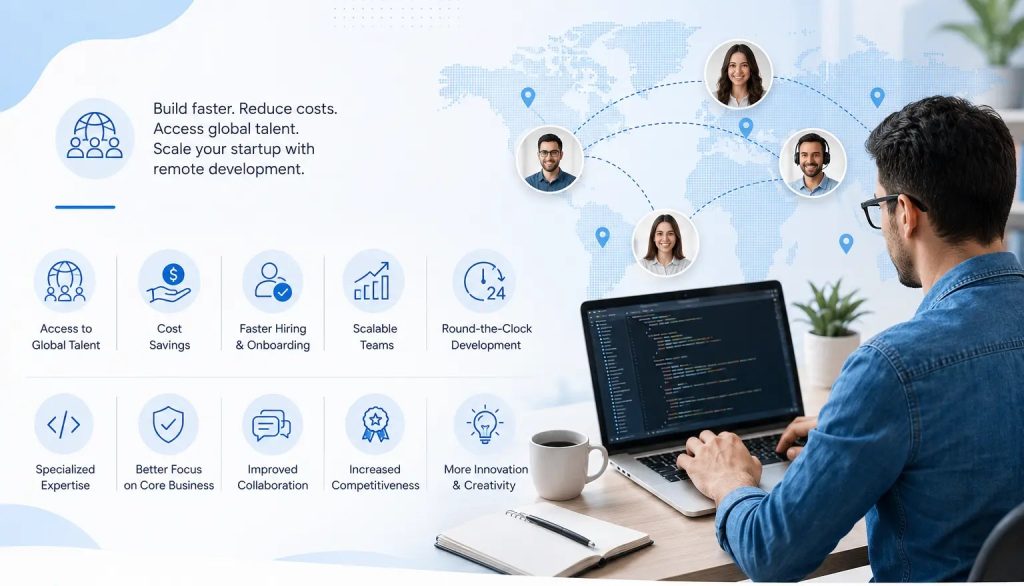

The global outsourcing market is on track to exceed $1.02 trillion in 2026 and grow to $1.35 trillion by 2031. Deloitte reports that 87% of organizations now treat third-party and outsourced talent as a core part of their workforce planning. Offshore teams are no longer a cost-cutting shortcut, they are a strategic imperative.
Yet despite the maturity of the market, the failure patterns have barely changed. The 2025 Deloitte Global Outsourcing Survey found that nearly 1 in 3 businesses reported dissatisfaction with at least one outsourced function in the prior 12 months. The root causes are almost always the same: poor planning, vague expectations, and choosing the wrong partner.
What makes 2026 uniquely demanding is the convergence of three forces: AI is now a baseline expectation, not a premium; product cycles have compressed dramatically (what took 12 months in 2022 can be obsoleted by a competitor in 5); and data regulations are tightening globally. Mistakes that were recoverable a few years ago can now derail entire product lines or trigger regulatory action.
This guide covers the 10 most critical offshore outsourcing mistakes that derail engagements in 2026, along with actionable fixes and the traits to look for in a partner like Global Teams AI that help you get it right the first time.
10 Outsourcing Mistakes to Avoid When Hiring Offshore Teams
Although outsourcing comes with great benefits and return on investment, there are various common mistakes that can hamper the operation and process. Here are some of those common mistakes, businesses need to be careful about and how can they handle them.
- Prioritizing Cost Over Quality & Capability
This is the original offshore outsourcing sin, and in 2026, it’s become even more expensive to commit. When businesses select offshore vendors purely on rate cards, they set off a chain reaction: the lowest-bid vendor wins the contract, delivers below expectations, requires constant oversight and rework, and ultimately costs 2–3x more than a higher-quality provider would have.
Why It Happens
Procurement pressure, tight budgets, and the sheer number of providers advertising rock-bottom rates make cost-first selection feel rational. It isn’t. The total cost of an offshore engagement includes onboarding time, manager oversight hours, rework cycles, communication overhead, and the opportunity cost of delayed output, none of which appear on a rate card.
Things to Look Out For
- Vendor can’t demonstrate work samples or case studies for your specific use case
- Quoted rate is 40%+ below market average with no explanation of how quality is maintained
- Team is described as “scalable to any size instantly”, a sign of body-shopping, not curated talent
- No mention of vetting processes, pre-training, or AI tool proficiency
How to Avoid It
Evaluate vendors on a total-value basis, not hourly rate. Define your must-have competencies before talking to any vendor. In 2026, AI proficiency, not just task execution, should be a core screening criterion. Ask specifically: What AI tools does your team use daily? How are new hires assessed for AI-readiness?
Global Teams AI Advantage: Pre-trained, AI-native talent across virtual assistant, IT, and BPO roles, with rigorous multi-stage screening that filters for both hard skills and AI tool proficiency. High-output teams at competitive rates, without sacrificing capability.
- Poor Vendor Selection & Due Diligence
The shift from transactional vendor selection to strategic partner selection is the single largest lever available to businesses outsourcing in 2026. Most failed engagements trace back to a procurement decision made faster than the diligence required to make it well.
Why It Happens
Hiring timelines are compressed. Leaders want teams deployed in weeks. Demo calls feel impressive. Proposals look polished. Without a structured vetting framework, confirmation bias takes over, you hire the vendor who said what you wanted to hear.
Red Flags to Watch
- References are all internal testimonials, with no verifiable external clients
- Vendor can’t describe their recruitment and screening process in detail
- Unwillingness to offer a paid pilot or structured trial before a long-term commitment
- The team presented in the sales cycle differs from the team you’ll actually work with
How to Avoid It
Build a vendor scorecard covering: technical skills validation, communication assessment, cultural fit indicators, AI tool proficiency, security posture, and client references with direct contacts. Run a structured behavioral interview for key roles, probing how candidates handle unclear requirements, missed estimates, and conflict escalation.
| Criterion | Weak Vendor | Strong Partner |
| Screening process | Resume review + 1 interview | Multi-stage: skills, communication, AI proficiency, cultural fit |
| Client references | Internal testimonials only | Verifiable external references, direct contact provided |
| Trial availability | 6-month minimum commitment | Paid pilot or risk-free trial offered |
| Value proposition | “More people at lower cost” | Outcome accountability, AI-augmented efficiency, measurable KPIs |
Unclear Goals, Scope & SLAs
Vague goals produce vague results. This is one of the most documented, and most consistently repeated, offshore outsourcing mistakes in business process outsourcing. Yet it remains near the top of every failure post-mortem.
Why It Happens
Stakeholders rush to deployment without investing in specification. “Improve customer support” feels specific enough in a kickoff meeting. Six months later, the vendor has hit every SLA metric while customer satisfaction has quietly declined, because the SLA measured speed and volume, not quality or business impact.
How to Avoid It
Before signing any contract, document: the specific deliverables expected, measurable KPIs for each function, escalation protocols and response-time SLAs, quality review cadences, remediation clauses for missed targets, and what “done” looks like for each milestone.
Rather than “improve SEO”, define: “rank in the top 5 positions for 3 target keywords within 90 days.” Rather than “handle customer tickets”, define: “achieve first-response time under 2 hours and CSAT above 4.2/5 by week 8.”
Common SLA Trap: Building SLAs that measure activity (tickets closed, lines of code written) instead of outcomes (customer retention, bug rate per release, upsell conversion). In 2026, with AI tools accelerating output volume, activity-based SLAs are especially misleading.
SLA Essentials for Offshore Engagements
- Turnaround time by task type and priority level
- Quality benchmarks (error rate thresholds, revision caps)
- Communication availability windows and response time expectations
- Reporting frequency and format
- Penalty and remediation clauses for consistent SLA misses
- Review and renegotiation schedule (at least quarterly)
- Communication Breakdowns & Async Failures
Communication failure is the most visible offshore team challenge, and also the most preventable. The problem is rarely language. It’s the absence of structure around how information flows, how decisions are made, and how blockers surface before they become crises.
Why It Happens
Companies assume a shared Slack channel and weekly standups are sufficient infrastructure for a distributed team. They’re not. Offshore teams operating under uncertainty, unclear requirements, midstream expectation changes, no clear escalation path, default to silence rather than risking a wrong assumption. Problems compound invisibly until they explode.
A Scenario That Plays Out Constantly
A portfolio company requests a regional margin bridge. The internal team needs management commentary. The vendor delivers only spreadsheet variance analysis. Neither side was wrong, the requirement was never explicitly defined. Three days of rework follow, plus trust erosion on both sides.
How to Avoid It
Build an async-first communication infrastructure before Day 1 of any offshore engagement:
- Centralized project hub (Notion, Jira, ClickUp) where all tasks, context, and decisions live
- Documented escalation paths: who to contact, on which channel, within what timeframe, for which class of issue
- At least 2–3 hours of daily working-hours overlap for real-time unblocking
- Designate a single point of contact on both sides with clear authority
- Structured daily async updates (15-minute written standups) rather than ad-hoc pings
- Establish a “flag early” culture, reward offshore team members who surface problems proactively
- Conduct weekly retrospectives for the first 60 days to identify process friction
Global Teams AI Advantage: All team members are assessed for communication quality, proactive problem-flagging, and autonomous working style, not just technical depth. Dedicated account management ensures your processes are set up for success from day one. See our Virtual Assistant services →
- Ignoring Time Zones, Culture & Working Styles
Time zone differences don’t pose a problem. Uncertainty does. The companies that successfully run global offshore teams don’t pretend timezone gaps don’t exist, they design workflows that make the gaps irrelevant.
Why It Happens
Executives evaluate offshore destinations by cost and skill availability without fully accounting for operational friction. A team with zero timezone overlap requires all coordination to happen asynchronously, which demands significantly more documentation discipline and process maturity than most clients have at the start.
Cultural misalignment is subtler but equally damaging. In many offshore markets, direct disagreement with a client’s instructions is culturally discouraged, even when instructions are ambiguous or counterproductive. If you don’t actively build a culture of candor, your offshore team will silently execute the wrong thing correctly.
How to Avoid It
Evaluate time zone overlap during vendor selection, not as an afterthought. For high-communication roles (project managers, customer-facing support, technical leads), prioritize vendors with at least 3–4 hours of working-hours overlap. For execution-heavy roles, build async workflows robust enough to run with zero overlap.
On cultural fit: run a structured onboarding session that explicitly establishes norms around candor, problem escalation, and disagreement. Make it clear that raising concerns early is valued, not penalized. Reinforce this consistently in the first 90 days.
The Follow-the-Sun Model Done Right: Companies that design for time zone differences, routing first-response customer tickets to offshore teams during off-hours, passing context through structured handoff documents, and using overlapping hours for decisions only, achieve 24/7 coverage without 24/7 overhead. The keyword is design, not wishful thinking.
- Inadequate Data Security & Compliance Controls
This is the mistake with the most catastrophic downside. In 2025, the average global cost of a data breach reached $4.44 million, and in the United States, the average cost climbed to $10.22 million, according to IBM’s Cost of a Data Breach Report 2025. With 65% of large companies citing third-party and supply-chain risk as their biggest cyber resilience barrier, offshore data security is no longer a due-diligence checkbox. It’s a board-level conversation.
Why It Happens
Businesses assume standard NDAs and basic access controls are sufficient. They’re not. In offshore environments, risks multiply: multiple team members accessing sensitive data from various physical locations, potentially on shared or personal devices, under varying national data protection frameworks, with less visibility into insider threat risks.
Red Flags to Watch
- Vendor cannot demonstrate SOC 2 Type II or ISO 27001 certification (or equivalent)
- No documented data classification and handling policy
- Offshore team members use personal devices without MDM controls
- No clear breach notification procedure (especially critical under GDPR’s 72-hour reporting window)
- Access controls are “trust-based” rather than role-based with audit logging
How to Avoid It
Before sharing any sensitive data with an offshore team, verify their security certifications, data handling policies, access control architecture, breach response procedures, and jurisdiction-specific compliance posture (GDPR, HIPAA, CCPA, or your applicable regulation). Include a Data Processing Agreement (DPA) in every contract. Conduct periodic security audits, at least annually, or after any significant team change.
2025 Regulatory Context: GDPR enforcement in Europe reached €1.2 billion in fines in 2025. A single breach-notification failure cost one global tech company €645 million. The World Economic Forum reports that 65% of large companies now cite third-party supply-chain risk as their biggest cyber resilience barrier. Offshore teams without verified security infrastructure are a direct vector into your systems.
- Lack of Process Documentation & Knowledge Transfer
When offshore outsourcing fails, the cause is usually internal, undocumented processes, coordination gaps, and context that lives only in someone’s head. You can hire the best offshore team in the world and still fail if you send them into an undocumented operation and expect them to reverse-engineer your processes mid-execution.
Why It Happens
Businesses that have operated the same way for years often have deep institutional knowledge that’s entirely informal. Nobody has ever needed to write down how the sales handoff works, or what “quality” means for a customer email response, because everyone who executes it has years of context. An offshore team has none of that context on Day 1.
The result: vendors learn the process by making mistakes during execution. Savings in the first month, loss of control by the sixth.
How to Avoid It
Before any offshore engagement launches, invest 2–4 weeks in process documentation. This means:
- Process maps for every function being outsourced
- Exception management policies (what happens when the standard process doesn’t apply)
- System access guides and permissions documentation
- Training materials with recorded video walkthroughs for complex processes
- A “playbook” for your top 20 task types before the team starts
- A living FAQ document updated weekly in the first 90 days
- A structured 30-60-90 day onboarding plan with clear competency milestones
The Documentation Dividend: Companies that invest in documentation before outsourcing consistently report faster ramp-up times, lower error rates, and higher retention of offshore team members. When people understand why they’re doing what they’re doing, not just how, quality and ownership both improve.
- No Exit Strategy or Contingency Plan
Every outsourcing engagement will eventually end, through vendor change, business restructuring, service internalization, or performance failure. Companies that don’t plan for this from Day 1 pay a steep price when the moment arrives.
Why It Happens
When you’re excited about a new vendor relationship, “what happens if this goes wrong” feels unnecessarily pessimistic. It isn’t. Switching vendors mid-product can take three to four months of disrupted velocity, and the institutional knowledge held by the departing team is rarely transferred cleanly. Companies on their second or third offshore partner struggle to close the momentum gap compared to those who got it right the first time.
What a Good Exit Strategy Includes
- Notice period: Minimum 30–90 days documented in the contract, with mutual obligations defined
- Knowledge transfer protocol: Step-by-step process for handing back all documentation, code, data, and context
- Data retrieval and deletion: Clear procedure for what happens to your data post-engagement
- IP ownership confirmation: Written confirmation that all work product transfers to you upon contract end
- Continuity plan: Who handles the function during the transition? Is there a parallel run period?
- Performance-triggered exit clause: Specific conditions under which either party can exit without penalty
IP Trap to Avoid: Some offshore contracts, particularly in software development, contain ambiguous IP ownership language. If not explicitly addressed, the vendor may retain rights to the work product. Always have legal counsel review IP clauses before signing any offshore development contract.
- Treating Offshore Teams as Vendors, Not Partners
The companies that get the most out of offshore outsourcing treat their teams the way they treat internal hires: with investment, context, feedback, and genuine inclusion. The companies that consistently struggle treat offshore teams as transactional resources, bodies deployed to execute tasks, not people engaged to solve problems.
Why It Happens
The “outsourcing” mental model primes clients to think transactionally. You define the output, they deliver it, you pay the invoice. This works for truly commoditized tasks. It fails for anything requiring judgment, creativity, relationship-building, or continuous improvement.
Research shows that teams treated as strategic partners, given business context, included in planning conversations, and given genuine performance feedback, demonstrate higher output quality, lower attrition, and greater proactivity. The cost of losing an experienced offshore team member and retraining a replacement is rarely factored into the “vendor vs. partner” calculus. It should be.
How to Avoid It
- Include offshore team leads in relevant planning meetings, not just execution briefings
- Share business context, why a project matters, what success looks like for the company
- Give structured, regular performance feedback (not just when something goes wrong)
- Celebrate wins publicly; acknowledge the offshore team’s contribution in company communications
- Invest in their professional development: training, certifications, AI tool access
- Build a relationship with individual team members, not just the account manager
Global Teams AI Approach: We match clients not just to skilled talent, but to team members aligned with your working style, values, and growth trajectory. Our flexibility model allows teams to scale and adapt as your business evolves, treating the relationship as ongoing rather than transactional. Explore IT Outsourcing →
Read More: Top IT Outsourcing Mistakes and How to Avoid Them in 2026
- Underestimating AI Integration & Tool Readiness
This is the defining offshore outsourcing mistake of 2026. Outsourcing performance now depends on automation maturity, AI governance, and outcome accountability, not just headcount. Vendors that lack these capabilities show slower turnaround and higher error rates. If a provider’s value proposition centers on “more people,” the cost structure is already inefficient.
Why It Happens
Most outsourcing vendor evaluation frameworks were designed for a pre-AI world. They assess headcount, turnaround times, cost per task, and experience credentials. They don’t ask: What AI tools is this team using daily? How have those tools changed their throughput? What’s their governance model for AI-generated outputs?
Firms that adopt AI-first outsourcing strategies achieve higher throughput, lower rework, and tighter compliance control. Labor-only models are struggling to maintain margins or service quality at competitive prices. The divergence is accelerating.
How to Avoid It
Rewrite your vendor evaluation framework to explicitly assess AI readiness:
- Require vendors to describe their AI toolstack for your specific function (not a generic answer)
- Ask for case studies showing measurable productivity or quality improvements from AI adoption
- Assess whether offshore team members are augmented by AI or merely coexisting with it
- Establish AI usage and governance policies in your contract to manage quality and compliance risk
- Set AI proficiency benchmarks as part of SLA metrics going forward
Global Teams AI Advantage: Our talent is AI-native, not AI-curious. Every team member is screened for hands-on proficiency with relevant AI tools for their role. We don’t just place talent; we deploy AI-augmented teams built for 2026’s output expectations.
Read More: How to Manage Remote Teams Effectively and Efficiently in 2026
How to Choose the Right Offshore Partner in 2026
Use this checklist before committing to any offshore outsourcing partner. It synthesizes the lessons from all 10 mistakes above into a practical vetting and selection framework.
Vendor Vetting Checklist
- Multi-stage screening process verified (technical, communication, AI proficiency, cultural fit)
- Verifiable client references with direct contact information provided
- Detailed description of recruitment, onboarding, and quality control processes
- Demonstrated AI tool proficiency relevant to your function
- Transparent pricing model with total-cost breakdown (not just hourly rate)
- Security certifications: SOC 2 Type II, ISO 27001, or equivalent
- Documented data handling, access control, and breach notification procedures
- Trial period or pilot project available before long-term commitment
- Clear SLA framework with outcome-based (not just activity-based) metrics
- Defined IP ownership, data retrieval, and exit procedures in contract
- Time zone overlap assessed for role requirements (minimum 3 hrs for high-communication roles)
- Dedicated account management or client success support included
- Scalability model verified: can team size adjust within 2–4 weeks based on business need?
- NDA and Data Processing Agreement available before any sensitive information is shared
Why Global Teams AI Passes This Checklist
Global Teams AI offers pre-trained, AI-native offshore talent across virtual assistant, IT, and BPO functions, with a rigorous multi-stage vetting process, a 7-day risk-free trial guarantee, enterprise-grade security practices, and flexible scaling that adapts to your business without the red tape of traditional outsourcing models.
Whether you need a single AI-augmented virtual assistant or a full offshore operations team, Global Teams AI structures each engagement around outcomes, not headcount.
Conclusion
10 mistakes covered in this guide are not exotic edge cases. They are predictable, well-documented, and entirely avoidable. They appear again and again not because the mistakes are subtle, but because the decisions that produce them are made faster than the diligence required to prevent them.
The shift happening in 2026 is fundamental: outsourcing has moved from labor cost reduction to productivity improvement through automation and AI augmentation. Vendors are now evaluated on operational efficiency, AI readiness, and outcome accountability, not headcount. Companies that internalize this shift and apply the lessons above will compound a significant competitive advantage. Companies that don’t will find themselves on their second or third offshore partner, struggling to close the momentum gap.
The framework is clear: vet for quality and AI-readiness, define outcomes before starting, document your processes, build real communication infrastructure, treat your team as partners, and protect your data. Do these things, and offshore outsourcing becomes one of the highest-leverage capabilities available to your business.
Ready to outsource the right way? Schedule a free discovery call with Global Teams AI →
Frequently Asked Questions
The most common mistake is prioritizing cost over quality and capability. Businesses often select the cheapest vendor only to face high rework rates, communication failures, and delayed deliverables, costing far more in the long run. Vetting for skills, AI readiness, and cultural fit upfront prevents this costly cycle.
Establish clear async-first communication protocols, use overlapping working hours for key meetings, set up a centralized project hub (Slack, Notion, Jira), and define escalation paths. A dedicated account manager or team lead on the offshore side dramatically reduces communication failures. Document your “definition of done” for every task type before work begins.
At minimum, require NDAs and a Data Processing Agreement, SOC 2 Type II or ISO 27001 certification, data encryption at rest and in transit, role-based access controls with audit logging, and clear breach-notification procedures aligned with GDPR, HIPAA, or your applicable regulation. The average cost of a data breach in the U.S. reached $10.22 million in 2025, the security conversation belongs in your first vendor meeting, not your contract review.
A strong offshore SLA defines measurable outcome-based KPIs (not just activity metrics), escalation protocols, review cadences (at least quarterly), remediation clauses for missed targets, and exit conditions. Avoid vague language like “best efforts.” Every metric should be specific, auditable, and tied to business outcomes rather than volume or speed alone.
Global Teams AI provides pre-trained, AI-native talent across virtual assistant, IT, and BPO roles. With rigorous multi-stage screening, a 7-day risk-free trial, dedicated account management, and flexible scaling, they offer high-output offshore teams that combine competitive pricing with genuine capability.