
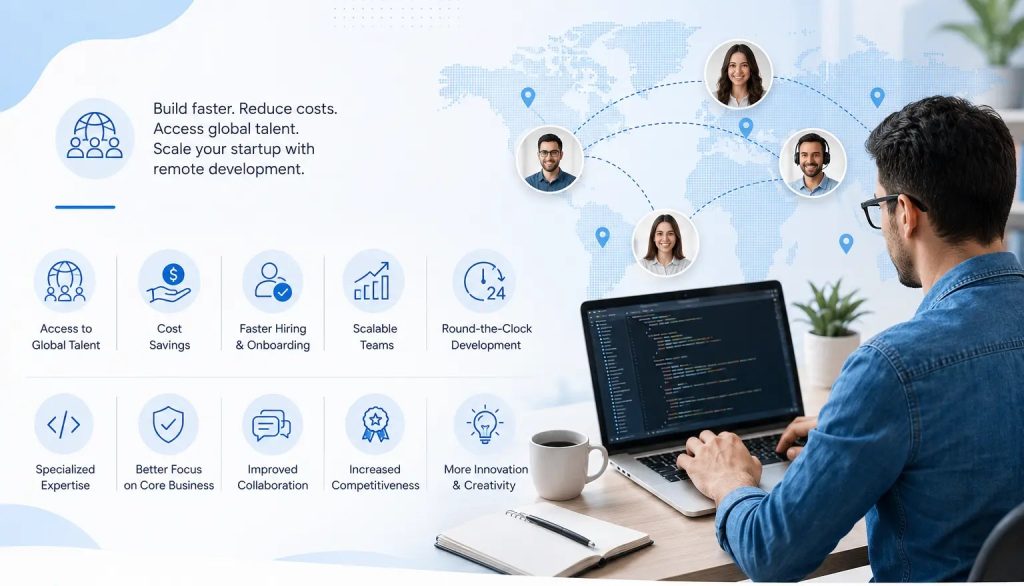
Building a startup is hard enough; finding the right web developer shouldn’t feel like searching for a unicorn. Remote work has transformed how startups build development teams. Instead of being limited to local talent, startups are increasingly hiring remote web developers to access global expertise, reduce hiring costs, and speed up product development. This approach helps overcome common challenges like limited budgets, tight deadlines, and skill shortages.
In this guide, we’ll explore the 10 key benefits of hiring remote web developers for startups and how they can help your business scale faster, improve efficiency, and stay competitive in today’s digital landscape.
Why Are Startups Turning to Remote Web Developers?
Startups today operate in a fast-paced environment where speed, flexibility, and access to the right talent are critical. Hiring remote web developers has evolved from a cost-saving option into a strategic growth decision. With modern collaboration tools like GitHub, Slack, and Jira, startups can seamlessly work with skilled developers from around the world, overcoming geographical limitations and gaining access to specialized expertise.
Remote hiring also gives startups the flexibility to scale and manage remote teams as business needs change, helping them launch products faster while keeping costs under control. By tapping into a global talent pool and building agile, distributed teams, startups can innovate more quickly, stay competitive, and focus on long-term growth.
Here are the 10 key benefits of hiring remote web developers for startups.
1. Access to a Global Talent Pool
Hiring remote web developers allows startups to access a global talent pool, making it easier to find developers with the right experience and technical expertise. This makes it easier to find developers with the right experience, technical expertise, and industry knowledge, ensuring you hire the best fit for your project rather than the closest available candidate.
A global talent pool also gives startups access to specialists in modern frameworks, programming languages, and emerging technologies that may be difficult to source locally. Additionally, working with developers from diverse backgrounds brings fresh perspectives and innovative ideas, helping teams solve problems creatively and build products that better meet the needs of a global audience.
2. Significant Cost Savings
Hiring remote web developers helps startups reduce both hiring and operational expenses without compromising on quality. By recruiting talent from different regions, startups can often find highly skilled developers at competitive rates, making it possible to optimize development costs while staying within budget.
In addition to lower hiring costs, remote teams eliminate many overhead expenses associated with in-house employees, such as office space, workstations, utilities, and employee benefits. These savings allow startups to allocate more of their budget toward product development, marketing, customer acquisition, and other growth initiatives that drive long-term success.
3. Faster Hiring and Onboarding
Startups often need to move quickly to seize market opportunities, making a lengthy recruitment process a major setback. Working with the right IT outsourcing partner shortens recruitment timelines by providing access to a global network of pre-vetted developers, reducing the time spent sourcing, interviewing, and filling technical roles. This allows businesses to build capable development teams in a fraction of the time it takes with traditional hiring.
A quicker onboarding process also helps projects get off the ground faster. Experienced remote developers are typically familiar with agile methodologies and digital collaboration tools, enabling them to integrate seamlessly into existing workflows. As a result, startups can accelerate product development, meet critical deadlines, and bring new products or features to market sooner.
4. Flexibility to Scale Teams Up or Down
Startup requirements can change rapidly as products evolve, funding milestones are reached, or market demands shift. A remote development model provides the flexibility to expand your team during high-growth phases, product launches, or large-scale projects without the delays and costs associated with traditional hiring. This ensures you always have the right level of technical support when you need it.
Once a project is completed or priorities change, teams can be scaled down without the long-term commitments of maintaining a large in-house workforce. This flexibility helps startups adapt quickly to changing business needs, optimize resources, and control costs while staying focused on growth and innovation.
5. Round-the-Clock Development with Time Zone Advantages
Working with remote web developers across different time zones enables development to continue beyond the traditional workday. As one team finishes its tasks, another can begin, creating a continuous workflow that keeps projects moving forward. This “follow-the-sun” approach helps startups make steady progress without unnecessary downtime.
Continuous development also speeds up feature releases, testing, and bug fixes, allowing issues to be addressed more quickly and reducing overall project turnaround times. For startups operating in competitive markets, this faster development cycle can accelerate product launches, improve responsiveness to customer feedback, and provide a valuable edge over competitors.
6. Access to Specialized Technical Expertise
Every startup has unique technical requirements, and remote hiring makes it easier to find developers with the exact skills needed for your project. Whether you’re building a web application with React, Laravel, Node.js, Python, or integrating cloud-based solutions, you can recruit professionals who are experienced in the technologies that align with your product goals.
Beyond technical proficiency, remote web developers often bring industry-specific knowledge from working across diverse projects and sectors. This specialized expertise helps startups implement best practices, solve complex challenges more efficiently, and develop high-quality, scalable solutions that support long-term business growth.
7. Increased Productivity and Focus
Remote web developers work in a performance-driven environment where success is measured by the quality and timely delivery of work rather than time spent in the office. This results-oriented approach encourages greater accountability and allows developers to focus on completing tasks efficiently while maintaining high development standards.
With fewer workplace distractions and the support of project management tools like Jira, Trello, and Asana, remote teams can collaborate effectively and track progress in real time. Clear milestones, regular updates, and measurable outcomes help startups maintain transparency, improve productivity, and ensure projects stay on schedule.
8. Reduced Overhead and Infrastructure Costs
Maintaining an in-house development team comes with significant operational expenses beyond salaries. Office rent, workspace maintenance, utilities, hardware, software licenses, and employee amenities can quickly increase costs, especially for startups operating with limited resources. Remote hiring eliminates many of these overhead expenses, allowing businesses to operate more efficiently.
By reducing investments in physical infrastructure and day-to-day office management, startups can significantly lower their long-term operational costs. The savings can then be redirected toward product innovation, marketing, customer acquisition, or business expansion, helping startups maximize their resources while supporting sustainable growth.
9. Better Focus on Core Business Activities
Startups thrive when founders can dedicate their time to strategic priorities such as product innovation, customer acquisition, and business growth. By entrusting technical development to experienced remote web developers, leadership teams can spend less time managing day-to-day development tasks and more time making decisions that drive the business forward.
Delegating technical execution to a skilled remote team also improves operational efficiency across the organization. With developers focused on building, testing, and maintaining the product, startups can streamline workflows, accelerate project delivery, and ensure that both technical and business objectives are achieved more effectively.
10. Long-Term Partnership and Retention Potential
Remote web developers can become valuable long-term partners as your startup grows. By working with the same developers across multiple projects, they gain a deeper understanding of your business goals, product vision, and technical architecture. This familiarity leads to better collaboration, faster decision-making, and more consistent development outcomes over time.
Building long-term relationships also helps retain critical technical knowledge within your team, reducing the learning curve for future updates and new features. As your business expands, a trusted remote development team can scale alongside you, providing stability, continuity, and the expertise needed to support long-term growth.
Remote Developers vs. In-House Developers
Remote developers enable startups to hire skilled professionals from a global talent pool while significantly reducing operational expenses such as office space, equipment, and employee benefits. In contrast, in-house developers offer closer on-site collaboration but come with higher recruitment, infrastructure, and long-term employment costs.
For startups aiming to scale quickly and optimize their budgets, remote development teams often provide greater agility and faster hiring without compromising on technical expertise.
The table below highlights the key differences between the two hiring models.
| Comparison Factor | Remote Developers | In-House Developers |
| Hiring Cost | Lower recruitment costs with access to global talent and competitive salary ranges. | Higher recruitment costs due to local hiring competition and longer hiring cycles. |
| Operational Cost | Minimal overhead with no office rent, utilities, or workspace maintenance. | Higher operational costs for office space, utilities, furniture, and maintenance. |
| Equipment & Infrastructure | Developers generally use their own equipment, reducing upfront investment. | Employers must provide laptops, workstations, software licenses, and office infrastructure. |
| Employee Benefits | Lower additional employment costs, depending on the hiring model. | Includes expenses for health insurance, paid leave, retirement benefits, and other perks. |
| Talent Pool | Access to skilled developers worldwide, including specialists in niche technologies. | Limited to the local or regional talent market. |
| Hiring Speed | Faster recruitment through global hiring platforms and pre-vetted talent. | Longer recruitment and onboarding process. |
| Scalability | Teams can be scaled up or down quickly as project needs change. | Scaling requires additional hiring and restructuring, making it slower. |
| Development Hours | Supports near 24/7 development through distributed teams across time zones. | Development is typically limited to standard business hours. |
| Flexibility | Highly adaptable for changing project requirements and business growth. | Less flexible due to permanent employment commitments. |
| Best Suited For | Startups seeking cost efficiency, scalability, and faster product delivery. | Organizations that require full-time, on-site collaboration and have larger operational budgets. |
How to Successfully Hire Remote Web Developers for Your Startup
Hiring the right remote web developers requires more than just reviewing resumes or technical portfolios. A structured hiring process helps startups identify professionals who not only have the required technical expertise but can also collaborate effectively, adapt to your workflows, and contribute to long-term business goals.
By following these best practices, you can build a reliable remote development team that delivers high-quality results.
Step 1: Clearly Define Your Project Requirements
Before starting the hiring process, outline your project scope, technical requirements, timelines, and expected deliverables. Clearly defining the programming languages, frameworks, and experience level you need will help attract the right candidates and streamline the selection process.
Step 2: Evaluate Technical Skills and Experience
Review candidates’ portfolios, previous projects, and technical expertise to ensure they have experience with the technologies your startup uses. Conduct coding assessments or technical interviews to validate their problem-solving abilities and ensure they can handle real-world development challenges.
Step 3: Assess Communication and Collaboration Skills
Technical expertise alone isn’t enough for successful remote collaboration. Look for developers who communicate clearly, respond promptly, and are comfortable using collaboration tools. Strong communication helps minimize misunderstandings, improves teamwork, and keeps projects moving efficiently.
Step 4: Use Reliable Project Management and Communication Tools
Successful remote teams rely on digital tools to stay organized and connected. Platforms such as Jira, Trello, Asana, Slack, GitHub, and Zoom help manage tasks, track progress, share code, and facilitate real-time communication, ensuring everyone stays aligned throughout the project.
Step 5: Start with a Paid Trial Project
A paid trial project is an effective way to evaluate a developer’s technical capabilities, communication style, and ability to meet deadlines before making a long-term commitment. It also allows both parties to assess whether the working relationship is a good fit.
Step 6: Prioritize Security and Confidentiality Agreements
Protecting your startup’s intellectual property and sensitive business information should be a top priority. Use Non-Disclosure Agreements (NDAs), clearly defined contracts, and secure access controls to safeguard your source code, customer data, and proprietary information while working with remote developers.
Common Challenges of Hiring Remote Web Developers
Hiring remote web developers can present challenges such as communication gaps, time zone differences, project visibility, and data security. If not managed effectively, these issues can impact collaboration, delay project timelines, and reduce overall productivity. However, with clear processes, the right tools, and well-defined expectations, startups can overcome these challenges and build high-performing remote development teams.
Here are the 5 common challenges of hiring remote web developers:
- Communication Across Different Time Zones
Working with developers in different time zones can sometimes delay meetings, feedback, or decision-making. Establishing overlapping working hours, setting clear response expectations, and scheduling regular check-ins can help maintain smooth communication and keep projects on track.
- Maintaining Collaboration and Team Culture
Remote teams may have fewer opportunities for spontaneous interactions, which can affect collaboration and team engagement. Encouraging regular video meetings, virtual team-building activities, and open communication helps build stronger relationships and fosters a collaborative work environment.
- Managing Project Visibility and Accountability
Without proper oversight, tracking project progress can become challenging. Using project management tools like Jira, Trello, or Asana, along with clearly defined milestones and regular progress updates, ensures transparency, accountability, and timely project delivery.
- Protecting Intellectual Property and Sensitive Data
Sharing source code and business information with remote teams requires strong security measures. Startups should use Non-Disclosure Agreements (NDAs), secure code repositories, role-based access controls, and encrypted communication channels to protect intellectual property and confidential business data.
- Best Practices to Overcome These Challenges
Building a successful remote development team starts with establishing clear communication guidelines, using reliable collaboration tools, setting measurable goals, and conducting regular performance reviews. Choosing trusted remote developers or working with reputable development partners also helps minimize risks and creates a productive, secure, and long-lasting working relationship.
Conclusion
Hiring remote web developers gives startups the flexibility to reduce costs, access global talent, scale teams quickly, and accelerate product development. With the right hiring strategy and collaboration tools, remote teams can drive innovation and support long-term business growth.
Ready to Scale Your Startup?
Global Teams AI connects startups with pre-vetted remote web developers who match your technical and business needs. Whether you’re building an MVP or expanding your engineering team, we help you hire top talent faster. Partner with Global Teams AI today and build your remote development team with confidence.
FAQs
Why should startups hire remote web developers instead of in-house developers?
Remote web developers offer lower costs, access to global talent, faster hiring, and greater flexibility, making them an ideal choice for startups looking to scale efficiently.
How much does it cost to hire remote web developers?
The cost varies based on experience, location, and technology stack, but remote developers are generally more affordable than maintaining an in-house development team.
What skills should I look for when hiring a remote web developer?
Look for expertise in relevant programming languages and frameworks, strong problem-solving abilities, effective communication skills, and experience with remote collaboration tools.
How do remote web developers communicate with startup teams?
They communicate through tools like Slack, Microsoft Teams, Zoom, Jira, Trello, Asana, and GitHub for seamless collaboration and project management.
Are remote web developers suitable for long-term projects?
Yes, hiring remote web developers is suitable for long-term projects. Remote developers can become long-term team members, providing continuity, product knowledge, and ongoing support as your startup grows.
What tools help manage remote web development teams effectively?
Popular tools include Jira, Trello, or Asana for project management, Slack or Microsoft Teams for communication, Zoom for meetings, and GitHub or GitLab for code collaboration.