
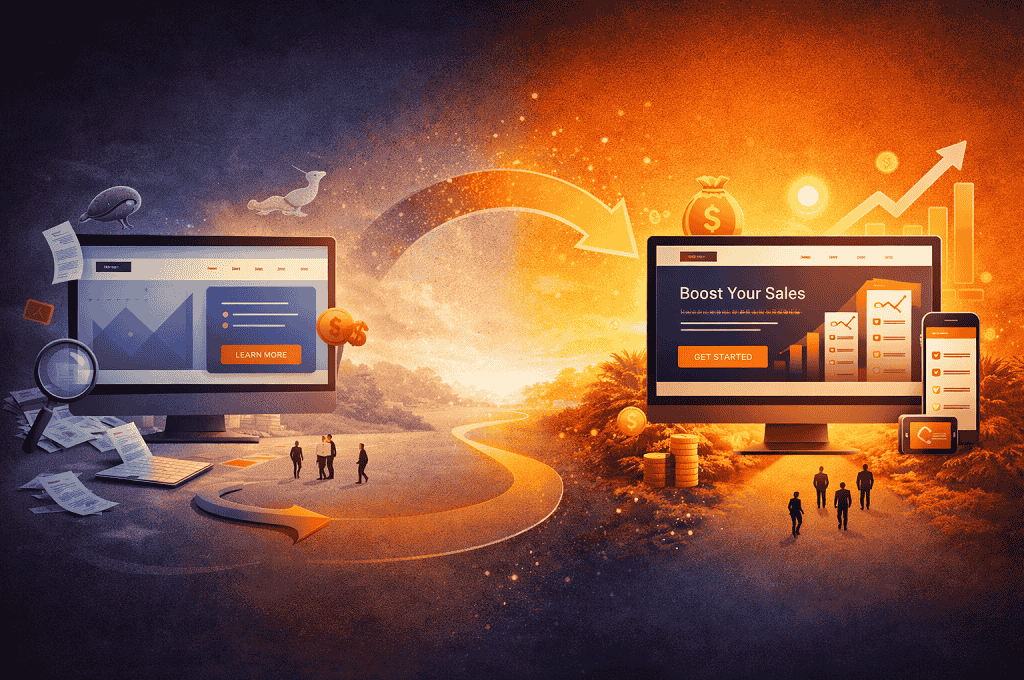
Businesses usually focus on how their website looks more than how it functions. As a result, most web development resources go into the colors, fonts and visuals. After all these, they wonder why the traffic is not turning into leads, conversions, and sales.
Yes, you can make your website visually appealing, there is no problem with that however, you need to focus on conversions too. Otherwise, you are just making an expensive decoration.
Factors such as poor technical execution, slow load timing, broken mobile experience, navigation issues and weak call to actions can impact the revenue. This means, the business website can drive traffic but there can be a huge gap between the number of visitors and the number who actually convert into potential customers.
This is where businesses need to focus on conversion-focused web development. Conversion-focused web development aligns your UX, performance, structure, and integrations directly with your business objectives. This makes it different from standard web development that treats design and functionality as separate goals.
In this blog, we will cover everything you need to know about how conversion-focused web development can double your conversions. And we will also understand that outsourcing web development services can be the best business decision for your business.
Key Highlights
- Most websites do not convert visitors to customers due to their overemphasis on aesthetics and lack of attention to performance, usability, and calls to action.
- Conversion-focused web development is an approach to web development where user experience, speed, structure, and tools are optimized to convert visitors to customers.
- The main reasons why conversion-focused web development increases conversion rates include fast load speeds, ease of navigation, powerful calls to action, mobile-first development, landing page optimization, and continuous improvement based on data.
- By solving conversion bottlenecks and integrating marketing tools, businesses can improve their conversion rates by a lot without necessarily increasing their traffic. This makes conversion-focused web development a high ROI activity.
Why Most Websites Don’t Convert
Many business owners and founders face similar challenges. You launch your website and go live and then you start driving traffic and wait. The visitors come and the number of traffic goes through the ceiling but there are no conversions. If you have faced similar issues, then don’t worry you are among thousands of business owners who face the similar problem. That said, the core reason for these problems is one or more of the following.
- Slow loading and poor performance: Akamai claims that a delay in the loading time of a page by one second can result in a reduction in conversions by up to 7%. The attention span and patience of people have reduced to a large extent. They would not wait to get the content on the website. It is also important to understand that if the loading time of a website is more than three seconds, then one has already lost a huge number of visitors without letting them read a single word on the website. This is because they would already be gone.
- Confusing navigation: When people are not immediately able to grasp where to go or what to do on your site, they will not stay. This is because they will not be comfortable with anything that is slightly inconvenient for them. Why would they be? They have hundreds if not thousands of alternatives.
- Weak CTAs or an unclear value proposition: The call to action is the connection between interest and action. Make sure that your call to action is not weak or buried under five other calls to action. It is already very difficult to persuade traffic and leads; don’t make it even more complicated. Make your calls to action simple and something that provides value to your potential users.
- Non-responsive or mobile-unfriendly design: Stastisa reports as of Q4 2024, mobile devices account for 62.54% of global website traffic. This number has only grown since then. More than 60 percent of your overall traffic is coming from mobile devices. A non-responding design is actively working against your conversions and your search engine rankings. If your website is not mobile friendly, you will lose customers and that too very fast.
- Poor integration with marketing and sales tools: Even when your user is ready to convert, poor integration of your marketing and sales tools will result in lost leads.
How Conversion-Focused Web Development Doubles Results
Conversion-focused web development is web development and optimization process in such a way that the technical aspects of the website are geared toward business growth, more leads, more sales, etc. The beauty of this whole concept is that the power of this whole strategy is not in one single optimization technique; it is the result of multiple techniques being applied at the same time.
1. Optimized Website Speed
One of the most direct levers you have for improving your conversion rate is your website’s page speed. Google’s data has consistently shown that pages which load more quickly convert better.
Conversion-focused web development means that your website will have optimized images, efficient code, proper caching, content delivery networks, as well as a server configuration that minimizes latency. This means your website will load quickly regardless of the device or connection your visitor uses. And this means your visitor will have time to convert.
2. Intuitive User Experience (UX)
Your website should be easy to use. Your visitors shouldn’t have to think; they should simply flow through your website towards the conversion you want them to make.
This means a logical website structure, a page design that guides the visitor’s eye through the content, eliminating unnecessary steps, eliminating dead ends, as well as making the conversion process as short as possible.
3. Strong Calls-to-Action (CTAs)
CTA is not just good copy; it is the placement, the contrast, the hierarchy, and the context all working together to make something obvious and easy.
Conversion-oriented development means your CTAs are in a place where users naturally focus their attention, above the fold on key landing pages, at the end of product or service copy, and at all logical moments in the user journey where a decision is being made.
4. Mobile-First Development
Mobile first is not merely a design trend; it is a necessity. The truth is that most users access the internet via mobile devices. Therefore, your website is losing conversions with each and every passing minute if it is not mobile-friendly.
Mobile first means that your website is built first with small screens in mind and then scaled up to accommodate larger screens.
5. Landing Page Optimization
Landing pages are the places where traffic turns into leads, and they need particular attention.
Conversion-focused landing page creation means a tight, focused message with a singular goal per page. No distracting navigation elements taking the visitor away from the goal. No competing offers distracting from the singular message.
Just a compelling value proposition, relevant social proof, and a clear call-to-action.
6. Analytics and Continuous Improvement
One of the greatest opportunities for improving your web development today is one of the most overlooked: your data.
Conversion-focused development is ensuring that your infrastructure is sound for collecting, analyzing, and acting upon real data about your users.
That’s right; we’re talking about having a sound analytics setup, event tracking, heat maps, session recording, and even a process for A/B testing. The end result of this process is that there’s a compounding effect that occurs as each step builds upon the next to increase your overall conversion rate.
7. Integration With Tools and Automation
Another disconnected tool within your marketing stack means another potential gap within your conversion funnel.
Conversion-centric development means having clean, reliable integrations with your website, your CRM system, your email marketing tool, your analytics tools, or any other tool that plays a role in the customer journey. When you have seamless integration, you have better lead capture, faster follow-up, more data available to your sales team, and better visibility into what’s working within your marketing process as a whole.
How to Get Started With Conversion-Focused Web Development
No matter what it is you wish to accomplish, be it a new website or improving on an existing one, here is a basic outline you can follow:
- Step 1: Evaluate your existing website. Use tools like Google PageSpeed Insights, GTmetrix, and Hotjar to get a better understanding of your current situation. Where are you losing visitors? How quickly does your website load?
- Step 2: Evaluate your existing website. What are the largest bottlenecks in your existing website? What pages do you have the highest rate of exiting from?
- Step 3: Evaluate your optimization goals. What changes will have the largest impact on your existing conversion goals? These will typically be related to the speed of your existing website, mobile functionality, and call-to-action buttons.
- Step 4: Set up analytics. Before you go ahead and make any changes to your existing website, it is important that you can track the results. Set up event tracking, conversion goals, etc. Establish a baseline.
- Step 5: Partner with professional web development services. At GTeams.ai, we have execution-ready web development teams that can be integrated into your team instantly. This can be done at a fraction of the cost of hiring locally, with zero fees to get started.
Read More: Website Redesign Services: When You Need One and How Much It Really Costs
Conclusion
Your website is one of the most leveraged assets your business has or should have. And when it’s built on conversion-focused web development principles, it works for you 24/7, generating leads, converting those leads to customers, and doing so in a measurable, scalable way.
It’s not always the business with the most budget or the most traffic that wins online. It’s the business with a website built to convert, where every technical, design, and optimization decision is made with a singular focus: growth. Remember, investing in proper web development is a competitive advantage.
Ready to Turn Your Website into a Conversion Machine? Contact GTeams.ai today, we offer conversion-focused web development by global, execution-ready teams, integrated with your business, transparently priced, and with measurable results.
Whether you need a new website, a website audit, or a web development partner, we’re here to help you get more leads, more sales, and more growth from your online presence.
FAQs (Frequently Asked Questions)
What is Conversion-Focused Web Development?
Conversion-focused web development refers to an approach to web development that entails developing or creating a website with the ultimate aim of converting the visitor into a potential customer. This approach to web development entails various techniques to attain the best results for your business. These techniques include optimization, user experience, call to action, mobile first, and testing.
How Does Web Development Affect My Business Results?
Your website is often the first point of interaction between your business and potential customers. Therefore, any issues with web development will directly influence your business results. A well-developed website will always have a higher number of conversions compared to a poorly developed website.
Can Web Development Actually Double My Leads?
The answer is yes. In fact, that is not a stretch; you could be getting much more. There are many reasons your website may be experiencing problems, such as speed, mobile responsiveness, call to action problems, etc. Therefore, improving some of these areas may result in a dramatic increase in your website’s conversion rates. You may not need to bring twice as many visitors to your website to double your leads; you may need to convert twice as many visitors.
What kind of results can I expect to see from web development improvements?
The results of web development improvements can be immediate, such as seeing the results of improving page speeds or call-to-action buttons. Other results, like those of SEO-friendly structural changes, may take longer to see. A/B tests will give clear results within two to four weeks of conducting the test. The best course of action is to make the biggest impact with the easiest changes first.
Should I hire an agency for conversion-focused web development?
The answer to this question is yes, for most businesses. This is because web development for conversions involves a number of skills that cannot be replicated within an organization. Such a is especially true if your organization has no prior experience in web development. This is where an agency, especially one like GTeams.ai that has flexible, transparent, cost-effective models, will come in handy. The ROI on this type of project will be easy to see.