Your nurses didn’t spend years in school to spend half their shift on hold with insurance companies. Your front desk team didn’t sign up to manually chase prior authorizations, re-enter the same patient data across three systems, and still field a waiting room full of people who never got their appointment reminders. Yet here we are, and it’s costing the U.S. healthcare system far more than money. AI interns for healthcare are emerging as the practical answer: not to replace the people already on your team, but to finally take the administrative weight off their shoulders so they can do the work they actually came here to do.
The solution isn’t to keep hiring into a market that can’t supply enough qualified people. It’s to build a smarter layer of administrative support underneath your existing team, one that handles the repetitive, process-driven work so your clinical professionals can practice at the top of their license. That’s exactly what a gteams.ai AI Intern is built to do, starting at $699/month.
In this blog, we will cover everything you need to know about how an AI intern solves staffing crises for healthcare institutions.
What is Happening in the Healthcare Industry and Why is there a Staffing Crisis?
Before we talk about solutions, it’s worth being precise about the problem, because the staffing crisis conversation often focuses on vacancies when it should also be focused on what the people who are still there are being asked to do.
A Workforce Stretched Beyond Its Job Description
Over 6.5 million healthcare professionals are projected to exit the U.S. workforce by 2026, creating a shortfall of more than 4 million workers across clinical and support roles. The AAMC projects a physician shortage of up to 86,000 by 2036. The NSI’s 2026 Staffing Report found that more than 324,000 acute care RNs left their positions in 2025 alone, with the national RN turnover rate climbing back to 17.6%.
These are serious structural gaps. But here’s what the headline numbers don’t capture: the people who haven’t left are absorbing the workload of those who have. A team that was staffed for 20 is now doing the work of 27. And a significant chunk of that extra work isn’t clinical, it’s administrative.
The Administrative Burden Is a Clinical Problem
Physicians in the U.S. spend an estimated 2 hours on EHR and administrative tasks for every 1 hour of direct patient care. That ratio isn’t just inefficient, it’s a driver of the burnout that’s pushing good clinicians out of the workforce. The administrative burden on physicians accounts for 24% of the variation in physician burnout scores, according to healthcare workforce research.
For nursing staff, the picture is similar. Studies consistently show that nurses spend only 37% of their shift on direct patient care, the rest goes to documentation, coordination, and administrative follow-up that, in a better-resourced environment, would be handled by dedicated support staff.
More than 65% of hospitals report having operated below full clinical capacity because of staffing shortages, and a significant contributor to that gap isn’t the absence of clinical skills, it’s the absence of adequate administrative support for the clinical staff who are there.
What This Costs (Beyond the Balance Sheet)
Replacing a single bedside RN costs an average of $60,090 (2026 NSI Report). Replacing a physician can cost two to three times their annual salary, anywhere from $250,000 to nearly $1 million. And those figures don’t account for the compounding effect: when experienced people leave because of burnout driven by administrative overload, the remaining staff carries even more of that burden, accelerating the next wave of departures.
The intervention point isn’t only recruitment. It’s reducing the administrative load on the clinical professionals you already have, so they stay, so they thrive, and so they can actually practice medicine rather than manage paperwork.
Why Normal Hiring Doesn’t Fix the Healthcare Staffing Crisis?
Most healthcare administrators have tried the standard toolkit. Here’s why it keeps falling short.
Hiring More Administrative Staff In a Tight Market
The logical answer to administrative overload is to hire dedicated administrative staff. The problem is that healthcare admin roles face the same market pressures as clinical ones. Qualified billing coordinators, prior auth specialists, and medical records staff are in short supply, command salaries of $45,000–$75,000 plus benefits, take 6–10 weeks to onboard, and turn over frequently, often because the volume of manual work they inherit is unsustainable.
You’re solving an administrative workload problem by creating a new hiring problem.
Staffing Agencies are Fast, But Expensive
Staffing agencies can move quickly, but they add 25–50% markup to an already elevated wage. For facilities operating on thin margins, this is a stopgap that compounds the financial pressure rather than relieving it.
Pure AI Automation are Capable, But Incomplete
Fully automated AI tools, unattended bots, RPA systems, AI chatbots, can process structured tasks at scale. But healthcare administration is rarely fully structured. It involves judgment calls, patient communication that requires empathy, payer-specific nuances, and exception handling that pure automation handles poorly. Deployed without human oversight, these tools also carry meaningful HIPAA compliance risks.
Pure automation is a component of a solution, not the whole solution.
The Missing Middle
What most healthcare facilities actually need is something between “hire another full-time person” and “automate everything.” They need a skilled, trained human professional who is supported by AI tools, someone who can handle the volume, adapt to nuance, communicate with patients and payers, and work within your existing systems. That’s the AI Intern model.
What Do AI Interns for Healthcare Actually Do?
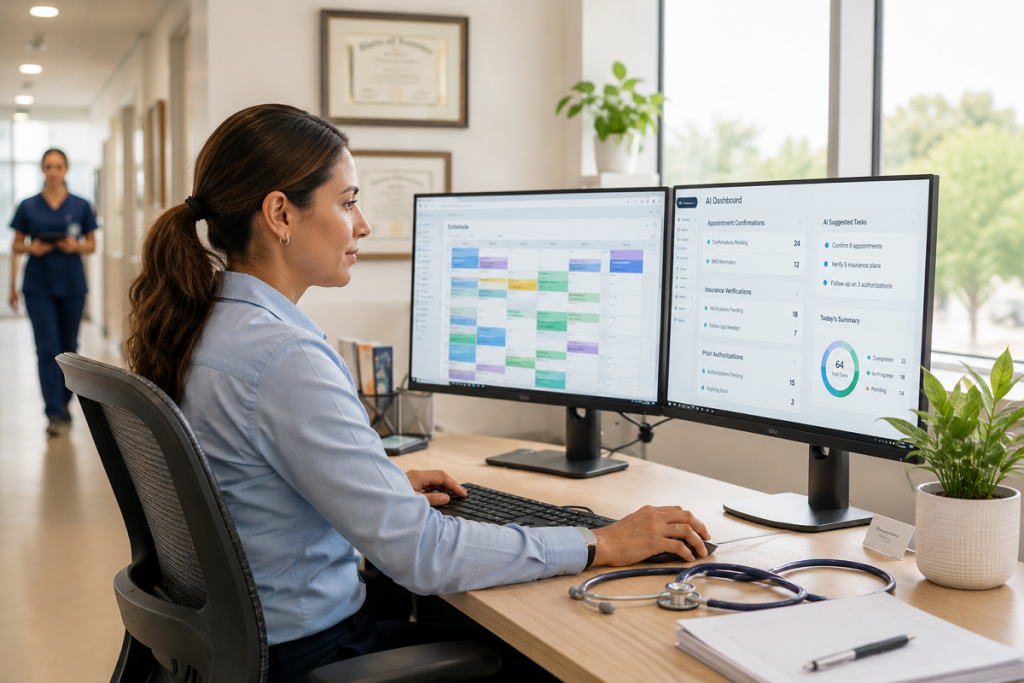
An AI intern from gteams.ai is a trained remote professional who works within your existing workflows, your EHR system, and your communication protocols, supported by AI-augmented tools that help them work faster and more accurately than a traditional administrative hire working manually.
The important distinction: AI Interns don’t replace your clinical team. They replace the administrative tasks that your clinical team was never supposed to be doing in the first place.
Taking Scheduling Off Your Clinical Staff’s Plate
When a nurse practitioner spends 20 minutes at the start of each day sorting through scheduling gaps and rescheduling requests, that’s 20 minutes they’re not in a room with a patient. An AI Intern handles:
- New patient appointment scheduling and confirmation
- Rescheduling requests and cancellation management
- Appointment reminder outreach (reducing no-show rates by up to 30%)
- Waitlist management and gap-filling when cancellations occur
- Multi-location scheduling coordination
Your front desk team and clinical staff focus on the patients who are in the building. The AI Intern manages the pipeline of patients who are coming.
Removing Insurance Verification from the Morning Huddle
Insurance eligibility verification before appointments is one of the most time-consuming and repetitive administrative tasks in outpatient healthcare, and when it doesn’t get done, it creates same-day cancellations, billing delays, and patient frustration. AI Interns handle:
- Pre-visit insurance eligibility checks for every scheduled appointment
- Coverage and benefits verification (deductibles, co-pays, out-of-pocket status)
- Flagging and resolving coverage discrepancies before the appointment
- Coordination with patients when coverage issues require attention
- Documentation of verification results in the EHR/practice management system
The result: your front desk team greets patients at check-in instead of scrambling to verify coverage in real time.
Handling Prior Authorization, Start to Finish
Prior authorization is one of the most universally dreaded administrative tasks in healthcare. The AMA reports that 94% of physicians say prior auth delays patient care, and the process consumes an average of two or more hours of physician and staff time per day in a busy practice. AI Interns take on:
- Initiating prior authorization requests with payers
- Tracking authorization status and following up on pending requests
- Documenting authorization numbers and expiration dates in the EHR
- Managing peer-to-peer review scheduling when denials occur
- Escalating urgent cases appropriately to clinical oversight
This doesn’t remove clinical judgment from the process, it removes the administrative legwork that surrounds that judgment. Your physicians focus on the clinical case; the AI Intern handles the paperwork and follow-through.
Medical Billing Support That Keeps Revenue Flowing
Billing errors and claim denials are expensive. The 2025 CAQH Index found that the U.S. healthcare industry avoided $258 billion in administrative costs through improved electronic transaction processing and automation, but significant avoidable costs remain in practices that rely on manual billing workflows. AI Interns support:
- Charge entry and claim preparation
- Claims submission coordination and tracking
- Denial identification and initial appeal support
- Patient statement preparation and basic billing inquiry response
- Insurance payment posting support
- ERA (Electronic Remittance Advice) reconciliation
Your billing team handles the complex exceptions and payer relationships. The AI Intern handles the high-volume, process-driven work that creates backlogs when your team is stretched.
EHR Data Entry and Records Management
EHR fatigue is one of the most cited drivers of physician burnout, and a significant portion of that fatigue comes from data entry and documentation tasks that don’t require clinical expertise. AI Interns take on:
- Structured data entry into EHR/practice management systems
- Medical records requests, processing, and release coordination
- Chart preparation and pre-visit documentation organization
- Referral tracking and coordination documentation
- Prescription refill request routing (to clinical staff for review and approval)
- Audit trail documentation and record accuracy checks
The clinical judgment involved in interpreting records or making clinical decisions remains entirely with your licensed staff. The AI Intern handles the moving, organizing, and structuring of the information that surrounds those decisions.
Patient Follow-Up and Communication
Consistent patient follow-up, care gap outreach, post-visit check-ins, chronic disease management reminders, dramatically improves clinical outcomes and patient satisfaction scores. But it’s chronically deprioritized in busy practices because clinical staff don’t have time. AI Interns handle:
- Post-visit follow-up calls and satisfaction check-ins
- Chronic care management outreach (flagged by clinical staff for contact)
- Preventive care reminders (annual wellness visits, overdue screenings)
- Care gap outreach for patients flagged in quality reporting
- Inbound patient inquiry handling and routing
Compliance Support and Documentation
- HIPAA-compliant documentation workflow maintenance
- Audit preparation and records organization
- Policy and procedure documentation support
- Credentialing documentation tracking and coordination
The Global Teams AI Model: $699/Month
At $699/month, a gteams.ai AI Intern provides full administrative support across your chosen workflows, at 50–70% below the fully-loaded cost of a traditional local administrative hire (salary + payroll taxes + benefits + PTO + recruiting + training). No recruitment fees. No onboarding lag measured in months. Operational within days.Benefits of Hiring AI Interns for Healthcare Industry.
| Support Model | Estimated Annual Cost | Time to Deploy | Scalability |
| Local admin hire (mid-market) | $80,000–$100,000+ | 6–12 weeks | Low |
| Staffing agency temp | 65000–$90000+ (with markup) | 2–4 weeks | Low |
| Pure AI automation | Varies — plus compliance risk | Instant | High but limited |
| gteams.ai AI Intern | 8388/year | 5–10 business days | Fast |
Your Clinical Staff Gets Their Time Back
The most important benefit of an AI Intern isn’t the cost saving, it’s what happens when your clinical staff stops doing administrative work.
A physician who recovers two hours of administrative time per day gains 10 hours per week of protected clinical, research, or recovery time. For a practice with five physicians, that’s 50 hours per week returned to the purpose your team was trained for. The downstream effects include reduced burnout, improved job satisfaction, lower turnover risk, and better patient outcomes.
A front desk team that isn’t manually chasing prior authorizations and verifying insurance in real time at check-in can focus on creating a welcoming, organized patient experience, the kind that drives satisfaction scores and loyalty.
A billing coordinator who isn’t manually entering charges for six hours a day can focus on denial management, payer relationship building, and revenue optimization, the high-value work that actually requires expertise.
Cost Savings That Compound
The financial math is direct. An AI intern at $699/month ($8,388/year) handling work that would otherwise require a $75,000–$90,000 administrative hire represents $66,000–$81,000 in direct annual savings, before you account for the productivity gains, reduced overtime, and lower turnover costs.
According to McKinsey and Harvard researchers, widespread AI adoption in healthcare administration could generate savings of $200–$360 billion annually across the U.S. system. For an individual practice, the impact is immediate and measurable.
For a group practice deploying two or three AI Interns across scheduling, billing support, and prior auth coordination, annual savings routinely reach $150,000–$200,000, with measurable improvements in revenue cycle performance.
24/7 Coverage Without Overtime
Patients don’t operate on a 9-to-5 schedule. Appointment requests come in evenings and weekends. Prior authorization follow-ups have payer deadlines that don’t respect your front desk hours. AI Interns can cover extended hours for scheduling and patient communication workflows without overtime costs or staffing complexity, ensuring your administrative operations don’t stall when your on-site team is off the clock.
Scalability When You Need It
Adding capacity with a traditional hire takes 6–12 weeks and locks you into fixed costs. Adding or adjusting an AI Intern takes days. For practices managing seasonal volume shifts, expanding to new locations, or navigating high-census periods, that flexibility is operationally significant.
Better Patient Experience
When your administrative layer is well-resourced, reminders go out consistently, scheduling errors are caught before the appointment, patients get follow-up calls within 24 hours of a visit, and patients notice. Response times improve. No-show rates drop. Patient satisfaction scores go up. These aren’t soft outcomes: they directly affect payer performance metrics, quality bonuses, and patient retention.
Read More: Get AI Work Done for Less: The Power of an AI Intern
Step by Step Process on How to Get Your AI Intern Up For Healthcare Industry
Deploying an AI Intern in a healthcare setting is more straightforward than most administrators expect, particularly when following a structured process built around compliance and integration.
Step 1: Identify Your Highest-Burden Workflows
Start with a two-week time audit across your administrative and clinical team. Where are the biggest bottlenecks? Where is clinical staff time being consumed by non-clinical tasks? Common findings include prior authorization queues building up, scheduling gaps going unfilled, insurance verification happening reactively at check-in, and billing backlogs growing during high-census periods. These become your AI Intern’s first priority areas.
Step 2: Define Scope and Access
Work with gteams.ai to define the specific tasks, systems, and communication channels your AI Intern will work within. This scoping ensures your AI Intern is set up to be productive from day one, and that all access is aligned with your facility’s security and compliance policies.
Step 3: EHR and Systems Integration
AI Interns are trained to work within the most widely used healthcare EHR and practice management systems, including Epic, athenahealth, eClinicalWorks, Kareo, NextGen, Greenway Health, and others. During onboarding, your AI Intern learns your specific workflows within these systems, no custom development, no IT project required.
Step 4: HIPAA Compliance Setup
Every gteams.ai AI Intern deployment operates under a Business Associate Agreement (BAA) a legal requirement under HIPAA for any vendor or workforce member handling Protected Health Information (PHI). The deployment framework includes:
- Role-based access control (minimum necessary access principle)
- Encrypted communication channels for all PHI handling
- Secure remote desktop or VPN environments for EHR access
- Clear data handling and retention protocols
- Regular access audits and permission reviews
Your AI Intern operates inside your security framework. They don’t introduce new compliance risk, they operate within the safeguards your facility has already established.
Step 5: Measure and Optimize
Within the first 30 days, establish baseline measurements and begin tracking the KPIs that matter to your facility:
| KPI | What It Tracks |
| Clinical staff hours recovered per week | Time returned from admin to patient care |
| Appointment no-show rate | Impact of consistent outreach and reminders |
| Prior auth turnaround time | Speed from request to approval |
| First-pass claim acceptance rate | Billing accuracy improvement |
| Claim denial rate | Revenue cycle health |
| Patient satisfaction scores | Front-end experience quality |
| Administrative cost per function | Efficiency vs. previous staffing model |
Most practices see measurable ROI within 30–60 days, frequently driven by no-show reduction and billing accuracy improvements within the first month.
Read More: The Role of AI Outsourcing: What Businesses Need to Know in 2026
Conclusion
The healthcare staffing crisis of 2026 has a workforce dimension that’s getting plenty of attention. What’s getting less attention is the operational dimension: the extraordinary amount of administrative work that has quietly become part of the clinical team’s job description, and the toll it’s taking on the people who keep healthcare running.
AI Interns for healthcare don’t solve the staffing crisis by replacing healthcare workers. They solve it by removing the administrative burden that’s burning your existing team out, slowing your revenue cycle, and pulling clinical attention away from the patients who need it.
At $699/month, a gteams.ai AI Intern is a dedicated, HIPAA-compliant administrative resource that integrates into your workflows, works inside your EHR, and handles the scheduling, verification, prior authorization, billing support, data entry, and patient follow-up that your clinical team was never meant to carry alone.
The result isn’t just cost savings, though those are real and significant. The result is a clinical team that can actually practice at the top of their license, a revenue cycle that runs with fewer errors and fewer delays, and a patient experience built on consistent, well-organized administrative support.
Your team came to healthcare to care for patients. Let’s make sure that’s what they’re spending their time doing.
Ready to Give Your Team Administrative Backup?
Start with a pilot, one AI Intern, your most burdened workflow, 30 days to see the difference.
Talk to the gteams.ai Healthcare Team → gteams.ai
Frequently Asked Questions
No, and that’s an important distinction. AI Interns handle administrative tasks, not clinical ones. They’re designed to support your existing team by removing the administrative workload that’s consuming clinical staff time, not to reduce clinical headcount. Most practices find that their clinical team’s capacity and satisfaction improves significantly when administrative relief is in place.
AI Interns are specifically trained for healthcare administrative workflows, they understand the nuances of insurance verification, prior authorization, medical billing, and EHR management in ways a general VA cannot. They work within HIPAA-compliant systems and are onboarded to your specific workflows, EHR, and payer environment. The AI-augmented tools they use help them work faster and more accurately than a traditional admin hire working manually.
Yes, every deployment includes a signed Business Associate Agreement (BAA). AI Interns operate within your security framework, role-based access, encrypted communications, secure EHR access environments, and compliance with your facility’s data handling policies.
Most practices have their AI Intern fully operational within 5–10 business days. Onboarding covers workflow scoping, EHR system access, and protocol training specific to your practice.
Yes, depending on volume, most AI Interns actively support 3–5 workflow areas simultaneously. For higher-volume practices, additional AI Interns can be deployed across different functional areas.