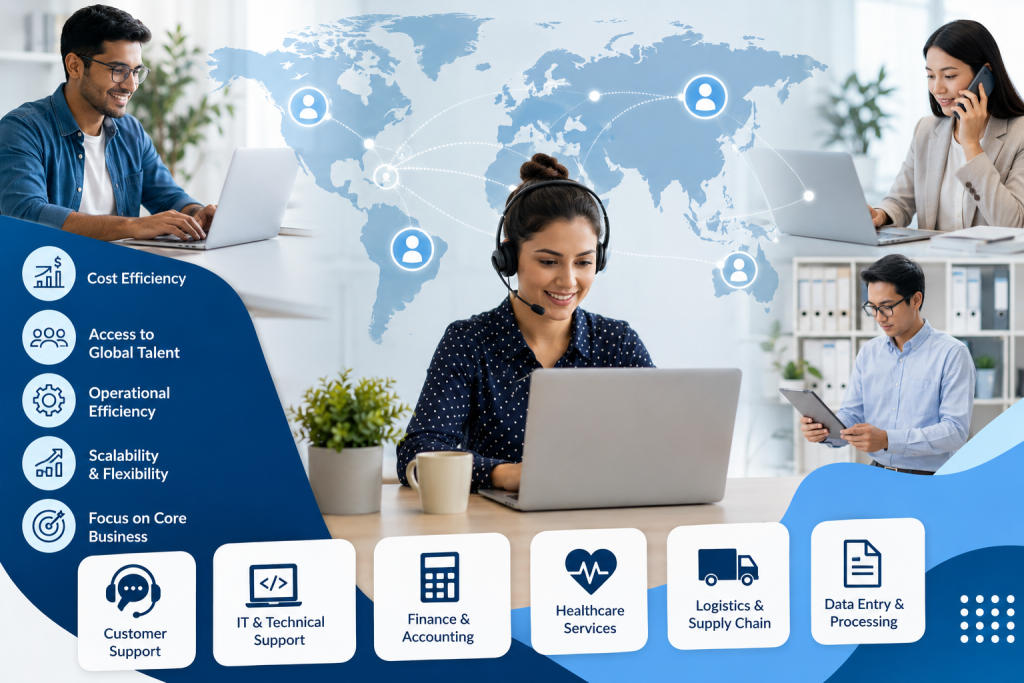
Scaling a global team requires businesses to manage rising costs, talent shortages, compliance, and operational complexity across multiple regions. Business Process Outsourcing (BPO) helps overcome these challenges by enabling organizations to outsource key business functions to experienced third-party service providers.
Beyond reducing costs, modern BPO supports access to global talent, improves operational efficiency, accelerates digital transformation through AI and process automation, and enables flexible growth.
This guide explains what BPO is, its benefits, outsourcing models, potential risks, and how to choose the right BPO provider for long-term business success.
What Is Business Process Outsourcing (BPO)?
Business Process Outsourcing (BPO) is the practice of contracting specific business processes or business functions to an external service provider that specializes in managing those operations. Rather than hiring, training, and overseeing internal teams for every operational function, organizations partner with experienced BPO companies that deliver specialized expertise, standardized processes, and scalable workforce solutions.
BPO has become an essential business strategy for organizations seeking operational efficiency, cost optimization, and access to global talent. Modern BPO providers support everything from customer-facing services to highly specialized back-office functions while leveraging advanced technology platforms, automation, analytics, and artificial intelligence to improve performance.
Depending on business objectives, organizations may outsource a single process or multiple interconnected business activities, allowing internal teams to focus on strategic growth, innovation, and customer experience.
Why Scaling Global Teams Is Challenging Without BPO
Scaling a global team without Business Process Outsourcing (BPO) requires businesses to overcome hiring costs, infrastructure investments, regulatory compliance, talent shortages, time zone differences, language barriers, and ongoing operational management. As organizations expand into new markets, managing these business processes internally becomes increasingly complex, often slowing growth and increasing costs.
Here are the Reasons why scaling Global Teams is challenging without BPO:
1. Operational and Cost Barriers
Expanding global operations internally requires significant investment in recruitment, onboarding, office infrastructure, technology platforms, and compliance. These expenses can quickly increase operational costs, particularly when hiring across multiple countries with different employment laws and regulatory requirements.
2. Hiring and Training Costs
Recruiting skilled employees in competitive markets is both time-consuming and expensive. Businesses must invest in sourcing candidates, conducting interviews, onboarding new hires, and providing role-specific training before employees become fully productive. High employee turnover can further increase recruitment and training costs, making sustainable growth more difficult.
3. Infrastructure and Technology Expenses
Supporting distributed teams requires reliable technology platforms, secure communication tools, payroll systems, collaboration software, cybersecurity measures, and IT infrastructure. Organizations expanding globally may also need regional offices, equipment, and local administrative support, creating substantial upfront and ongoing operational expenses.
4. Compliance and Regulatory Challenges
Every country has unique labor laws, tax regulations, payroll requirements, data protection standards, and employment obligations. Businesses expanding internationally must comply with these legal requirements to avoid penalties, legal disputes, or reputational risks. Managing compliance across multiple jurisdictions often requires dedicated legal, HR, and finance resources, increasing operational complexity.
5. Talent and Productivity Challenges
Even after establishing global operations, businesses must attract qualified professionals, coordinate distributed teams, maintain consistent communication, and ensure productivity across different locations. Without standardized process management, these challenges can reduce efficiency and hinder long-term growth.
6. Limited Access to Skilled Talent
Many organizations struggle to find qualified professionals within their local labor market, particularly for specialized roles in customer support, information technology, finance, and business intelligence. Restricted access to skilled talent can delay hiring, increase labor costs, and limit a company’s ability to scale efficiently.
7. Time Zone and Language Barriers
Operating across multiple countries introduces communication challenges caused by different time zones, languages, and cultural expectations. Delayed collaboration, inconsistent customer support coverage, and misunderstandings between teams can affect productivity, service quality, and project timelines unless businesses establish effective communication processes.
8. Management and Performance Tracking Issues
Managing distributed teams requires clear workflows, consistent reporting, performance metrics, and effective supervision. Without standardized processes and centralized monitoring, maintaining accountability, measuring productivity, and ensuring consistent service quality become increasingly difficult as the organization grows. Businesses may also struggle to identify operational inefficiencies and respond quickly to changing workforce demands, slowing overall business performance.
Step-by-Step Guide: How to Use BPO to Scale Your Global Team
Scaling a global team with Business Process Outsourcing (BPO) requires a strategic implementation plan rather than simply hiring an outsourcing company. Businesses should first identify which business processes are suitable for IT outsourcing. Following a structured approach reduces implementation risks, improves collaboration, and ensures outsourced operations contribute to long-term business growth rather than creating additional management challenges.
Here’s the step-by-step to use a BPO to Scale Global Teams:
Step 1: Identify Processes to Outsource
The first step in scaling your global team with BPO is identifying which business processes can be outsourced without affecting your competitive advantage. Start by evaluating repetitive, time-consuming, and standardized tasks that consume valuable internal resources but do not require direct strategic oversight.
Functions such as customer support, call center operations, human resources, payroll, finance and accounting, IT support, data entry, and back-office operations are often strong candidates because they follow well-defined workflows and can be managed efficiently by experienced BPO providers.
Conduct a process audit to determine which activities create operational bottlenecks, have high operating costs, or require specialized expertise that is difficult to hire locally. Prioritize processes based on business impact, outsourcing feasibility, implementation complexity, and expected return on investment. Beginning with lower-risk operational functions allows businesses to gain outsourcing experience before expanding BPO into more complex business activities.
Step 2: Choose the Right BPO Provider
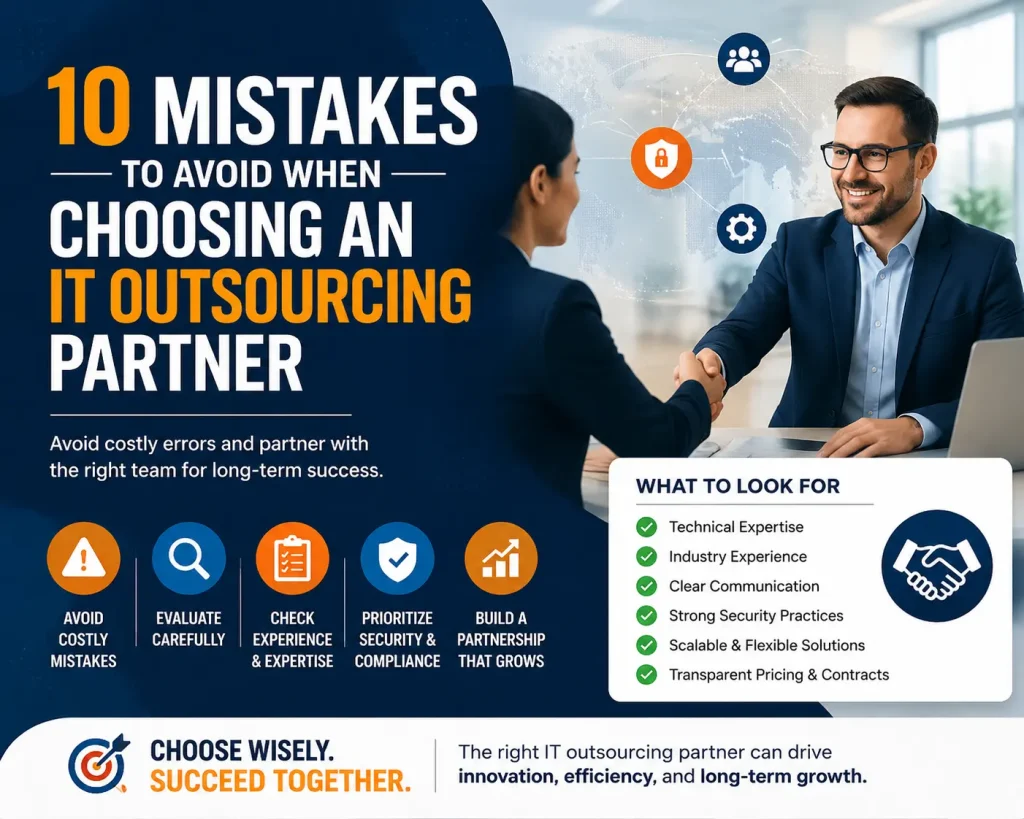
Selecting the right BPO provider is critical to achieving long-term outsourcing success. Rather than choosing a provider based solely on cost, evaluate their industry experience, service capabilities, technology platforms, workforce scalability, security practices, and ability to support your business objectives.
An experienced outsourcing partner should understand your industry, provide skilled professionals, and demonstrate proven expertise in managing similar business functions. To avoid making common IT outsourcing partner mistakes, take the time to evaluate potential vendors carefully and verify their experience, communication practices, and delivery capabilities before signing a contract.
Before making a decision, review client references, case studies, service-level agreements (SLAs), and compliance certifications. Assess how the provider manages employee training, quality assurance, data security, performance reporting, and communication. Choosing a provider with strong operational processes and a culture that aligns with your business reduces implementation risks and builds the foundation for a long-term strategic partnership.
Step 3: Set Clear KPIs and Expectations
After selecting a BPO provider, establish clear expectations and measurable Key Performance Indicators (KPIs) before outsourced operations begin. Define performance metrics that align with the outsourced business function, such as customer satisfaction, response times, service accuracy, productivity, turnaround times, or cost savings. Clearly documented goals ensure both your organization and the BPO provider understand what success looks like.
Equally important is creating a communication and reporting framework that supports transparency and accountability. Schedule regular performance reviews, operational meetings, and progress reports while defining escalation procedures and decision-making responsibilities. Continuous monitoring and feedback help identify improvement opportunities and ensure outsourced processes consistently meet business objectives.
Step 4: Onboard and Integrate Your BPO Team
Effective onboarding ensures your outsourced team becomes a seamless extension of your organization rather than operating as an independent external vendor. Provide comprehensive training on your products or services, business processes, customer expectations, company policies, and standard operating procedures. Sharing process documentation, knowledge bases, and workflow guides enables the BPO team to deliver consistent, high-quality service from the outset.
Integration should continue beyond the initial onboarding period through regular communication, collaboration, and performance support. Give outsourced employees access to the same project management, communication, CRM, and reporting tools used by internal teams whenever appropriate. Treating the BPO team as a strategic partner fosters stronger collaboration, improves productivity, and helps maintain consistent operational standards as your global workforce grows.
How BPO Enables Efficient Global Team Scaling
Business Process Outsourcing (BPO) enables efficient global team scaling by providing access to global talent, reducing operational costs, increasing workforce flexibility, and supporting faster business expansion without building large in-house teams. By leveraging specialized expertise and scalable business processes, organizations can grow more efficiently while maintaining operational quality.
The following are the key ways BPO supports successful global team expansion.
I. Access to a Global Talent Pool
BPO removes geographical hiring limitations by connecting businesses with qualified professionals across different regions. This allows organizations to recruit the right talent based on skills and experience rather than location, making it easier to fill roles quickly and support international growth.
II. Hiring Skilled Professionals Without Geographical Limits
Partnering with a BPO provider gives businesses immediate access to established recruitment networks and experienced professionals worldwide. Rather than setting up local entities or navigating regional hiring regulations, organizations can build global teams through trusted outsourcing partners while reducing recruitment time and administrative complexity.
III. Specialized Expertise on Demand
BPO companies provide professionals with expertise in customer service, human resources, finance and accounting, information technology, marketing, business intelligence, supply chain management, and other specialized business functions. Businesses can quickly access the skills they need for ongoing operations or specific projects without investing in extensive internal hiring and training.
IV. Cost Efficiency Without Quality Compromise
BPO helps organizations lower operating expenses while maintaining high service standards through optimized processes, shared resources, and experienced delivery teams. Instead of increasing fixed costs as they expand, businesses can adopt flexible outsourcing models that align expenses with operational needs.
V. Lower Operational Costs
Outsourcing business processes reduces costs associated with recruitment, employee benefits, office space, equipment, software licensing, and ongoing workforce management. Because BPO providers already have the necessary infrastructure, technology platforms, and trained personnel, businesses can scale more efficiently while avoiding large capital investments.
VI. Predictable Pricing Models
Most BPO providers offer structured pricing models based on full-time employees, project scope, transaction volume, or service usage. Predictable pricing helps organizations forecast operational expenses more accurately, simplify budgeting, and reduce unexpected costs as their global workforce expands.
VII. Reduced Overhead
Managing a larger internal workforce often increases administrative responsibilities across HR, payroll, compliance, IT support, and facility management. Outsourcing these business functions transfers many of these responsibilities to the BPO provider, allowing organizations to reduce overhead while focusing internal resources on growth initiatives and strategic decision-making.
VIII. Faster Scaling and Flexibility
Businesses need to change rapidly due to market conditions, customer demand, and business growth. BPO provides the flexibility to adjust workforce capacity without the delays and costs associated with traditional hiring, enabling organizations to respond quickly while maintaining operational continuity.
IX. Scale Teams Up or Down Quickly
BPO providers can rapidly increase or decrease staffing levels based on business requirements. Whether launching a new product, entering a new market, or responding to changing workloads, businesses can adjust team size without lengthy recruitment cycles or complex workforce restructuring.
X. Support Seasonal or Project-Based Needs
Many businesses experience temporary spikes in demand during seasonal periods, product launches, or short-term projects. BPO enables organizations to access additional skilled professionals only when needed, ensuring service levels remain consistent without committing to permanent hires. This flexible approach helps businesses maintain productivity, control costs, and support sustainable global expansion.
Key Benefits of BPO for Growing Businesses
Business Process Outsourcing (BPO) helps growing businesses improve operational efficiency, focus on core business activities, and strengthen their competitive advantage by streamlining business processes, reducing administrative workloads, and providing access to specialized expertise. By outsourcing non-core business functions to experienced BPO providers, organizations can scale more efficiently, improve service delivery, and allocate more resources toward strategic growth initiatives.
Below are the primary benefits of BPO for growing businesses:
1. Improved Operational Efficiency
BPO enables businesses to standardize workflows, optimize process management, and leverage automation to increase productivity while maintaining consistent service quality. Experienced outsourcing providers use proven operational frameworks and technology platforms to complete business processes more accurately and efficiently than many in-house teams.
2. Streamlined Workflows
Outsourcing repetitive and process-driven activities helps eliminate operational bottlenecks, reduce manual effort, and improve turnaround times. Standardized workflows also promote greater consistency across departments, making it easier to manage growing business operations and maintain service quality as the organization expands.
3. Process Management and Automation
Many BPO providers integrate process automation, robotic process automation (RPA), and business intelligence tools into their service delivery. Automating repetitive tasks reduces human error, accelerates processing times, improves reporting accuracy, and allows employees to focus on higher-value activities that contribute to business growth.
4. Focus on Core Business Activities
Delegating routine operational responsibilities allows internal teams to dedicate more time and expertise to initiatives that directly support business objectives. Rather than managing day-to-day administrative work, organizations can concentrate on innovation, customer relationships, and long-term planning.
5. Freeing Internal Teams from Routine Tasks
Administrative functions such as payroll, customer support, data processing, and back-office operations consume significant internal resources. Outsourcing these business functions reduces management burdens and enables employees to focus on revenue-generating activities, product development, and customer engagement.
6. Improving Innovation and Strategic Focus
With operational responsibilities handled by a trusted BPO provider, business leaders can devote greater attention to expanding into new markets, improving products and services, strengthening customer experiences, and executing long-term strategic initiatives that drive sustainable growth.
7. Competitive Advantage in Global Markets
BPO gives businesses the flexibility, responsiveness, and operational capacity needed to compete in increasingly global markets. Access to skilled professionals, scalable resources, and around-the-clock service delivery helps organizations improve customer satisfaction while responding more quickly to changing business demands.
8. Faster Response Times
Dedicated BPO teams enable businesses to respond more quickly to customer inquiries, process requests efficiently, and resolve issues with greater consistency. Faster service delivery improves customer satisfaction while supporting stronger operational performance across multiple markets.
9. 24/7 Operations Through Offshore Outsourcing
Offshore outsourcing allows businesses to provide continuous support by leveraging teams across different time zones. This around-the-clock operational model improves customer service availability, accelerates business processes, increases productivity, and ensures critical functions continue outside traditional business hours, helping organizations scale globally without significantly increasing internal staffing.
Types of BPO Models for Global Team Expansion
Businesses can scale global teams through geographic, operational, and management, and advanced BPO models, each designed to support different business goals, workforce strategies, and levels of operational control. The ideal outsourcing model depends on factors such as budget, collaboration requirements, regulatory obligations, access to specialized talent, and the complexity of the business processes being outsourced. Understanding these models helps organizations select the most effective BPO strategy for long-term growth.
1. Geographic Models
These models determine where your outsourced team is located, directly influencing labor costs, communication, time zone overlap, and regulatory considerations. Businesses typically choose between offshore, nearshore, and onshore outsourcing based on their priorities for cost savings, collaboration, and operational efficiency.
- Offshore BPO
Offshore BPO involves partnering with a BPO provider in a distant country, such as India, the Philippines, or Poland. It offers the greatest cost savings, access to a large global talent pool, and support for 24/7 operations across different time zones. However, businesses should establish effective communication processes to manage time zone differences and cultural variations.
- Nearshore BPO
Nearshore BPO involves outsourcing business processes to a neighboring country with a similar time zone, such as Mexico or Costa Rica, for US-based companies. It balances cost reduction with real-time collaboration, easier communication, and more convenient travel, making it well-suited for projects requiring frequent interaction.
- Onshore (Domestic) BPO
Onshore (Domestic) BPO involves working with a third-party service provider located within your own country. It is best suited for organizations that prioritize strict regulatory compliance, stronger data security, cultural alignment, and seamless communication, although it generally comes with higher labor and operating costs.
2. Operational and Management Models
Operational and management models define how the outsourced team is managed and integrated into your business. They determine whether your organization retains day-to-day control, shares management responsibilities, or fully delegates an entire business function to a BPO provider.
- Staff Augmentation (Remote Teams)
Staff Augmentation allows businesses to add dedicated remote professionals to their existing workforce while maintaining direct control over daily operations. The BPO provider manages recruitment, payroll, human resources, and infrastructure, while the client oversees tasks, priorities, and employee performance. This model is ideal for organizations with established management processes that need to quickly expand their teams.
- Managed Teams (Co-Sourcing)
Managed Teams, also known as Co-Sourcing, combine internal leadership with external operational management. The BPO provider recruits, manages, and supervises the outsourced team, while the client retains strategic oversight and sets business objectives. This collaborative approach reduces management workload while maintaining visibility into team performance.
- Managed Services
Managed Services involve outsourcing an entire business function, such as IT support, payroll, customer service, or finance and accounting, to a BPO company. The provider assumes responsibility for staffing, process management, technology, quality assurance, and service delivery according to agreed Service Level Agreements (SLAs), allowing the business to focus on strategic priorities.
3. Advanced and Specialized Models
Advanced and specialized BPO models support organizations with specific international hiring, ownership, or expertise requirements. These models extend beyond traditional outsourcing by helping businesses expand globally, establish dedicated operations, or access highly specialized professional services.
- Employer of Record (EOR)
An Employer of Record (EOR) enables businesses to hire international employees legally without establishing a local legal entity. The EOR acts as the legal employer by managing employment contracts, payroll, taxes, employee benefits, and labor law compliance, while the client directs employees’ day-to-day work. This model simplifies global hiring and accelerates international expansion.
- Captive Model
The Captive Model involves establishing a wholly owned overseas subsidiary that operates exclusively for the parent company. It provides complete control over employees, business processes, technology, and company culture, making it suitable for organizations with long-term global expansion plans. However, it requires significant investment in infrastructure, staffing, and regulatory compliance.
- Knowledge Process Outsourcing (KPO)
Knowledge Process Outsourcing (KPO) involves outsourcing highly specialized, knowledge-intensive business functions that require advanced expertise or professional qualifications. Common KPO services include financial modeling, legal research, engineering, business intelligence, market research, and data analytics. This model enables organizations to access specialized talent while improving the quality and efficiency of complex business processes.
Risks and Challenges of BPO
Business Process Outsourcing (BPO) can improve efficiency and reduce costs, but it also presents risks related to data security, communication, and service quality. Businesses can minimize these challenges by choosing experienced BPO providers, establishing clear agreements, implementing strong governance, and monitoring performance regularly. Proactive risk management helps build successful, long-term outsourcing partnerships.
- Security Issues and Data Protection
Outsourcing often requires sharing sensitive customer, employee, and business data with external service providers. Reduce security risks by choosing BPO providers that follow recognized compliance standards, implement strong cybersecurity measures, use confidentiality agreements, encrypt sensitive information, and conduct regular security audits to protect data and maintain regulatory compliance.
- Language and Cultural Barriers
Language differences and cultural expectations can affect communication, collaboration, and customer experience when working with global teams. Businesses can overcome these challenges by selecting providers with multilingual capabilities, providing cultural training, establishing clear communication guidelines, and holding regular meetings to ensure consistent service quality and team alignment.
- Hidden Costs and Performance Risks
Unexpected costs and inconsistent service can occur if outsourcing agreements lack clear expectations or pricing structures. Prevent these issues by defining transparent contracts, measurable Service Level Agreements (SLAs), Key Performance Indicators (KPIs), reporting schedules, and regular performance reviews to maintain accountability and continuously improve outsourced business processes.
Role of Technology in Modern BPO
Technology has transformed Business Process Outsourcing (BPO) from a labor-focused service into a strategic business solution that improves efficiency, accuracy, and scalability. Modern BPO providers use process automation, artificial intelligence (AI), robotic process automation (RPA), business intelligence, and cloud-based technology platforms to streamline business processes, reduce manual work, and deliver faster, data-driven services. These technologies help businesses scale global teams while maintaining operational quality and improving customer experiences.
- Process Automation and Robotic Process Automation (RPA)
Process automation and Robotic Process Automation (RPA) automate repetitive, rule-based tasks such as data entry, invoice processing, payroll administration, and report generation. By reducing manual effort and human error, RPA improves operational efficiency, increases processing speed, and allows employees to focus on higher-value activities that require critical thinking and decision-making.
- Artificial Intelligence in BPO
Artificial intelligence enables BPO providers to deliver smarter and more responsive services through AI-powered chatbots, virtual assistants, predictive analytics, and intelligent workflow automation. AI also strengthens business intelligence by analyzing large datasets, identifying trends, forecasting demand, and providing actionable insights that help businesses improve decision-making and customer service.
- Digital Transformation Through Outsourcing
BPO providers accelerate digital transformation by integrating modern technology platforms, cloud collaboration tools, workflow automation, analytics, and secure digital infrastructure into everyday operations. Rather than investing heavily in new technology internally, businesses can leverage the provider’s expertise and technology ecosystem to modernize business processes, improve scalability, and adapt more quickly to changing market demands.
When Is the Right Time to Adopt BPO?
Businesses should adopt Business Process Outsourcing (BPO) when rising operational costs, increasing workloads, talent shortages, or expansion plans begin limiting growth. Whether you’re a startup entering new markets, a growing business improving efficiency, or an enterprise optimizing global operations, BPO provides the expertise, scalability, and flexibility needed to support sustainable growth. The timing and outsourcing strategy should align with your business objectives, operational maturity, and long-term plans.
- Signs Your Business Is Ready for BPO
Several indicators suggest that outsourcing can improve business performance. Common signs include rising operating costs, difficulty hiring skilled talent, increasing administrative workloads, declining service quality, limited internal capacity, and plans to expand into new markets. If routine business functions are preventing your team from focusing on strategic initiatives, outsourcing these processes can improve efficiency and accelerate growth.
- Startups vs Mid-Sized vs Enterprise Needs
The way businesses use BPO often depends on their size and stage of growth. Startups typically outsource customer support, payroll, or administrative functions to control costs and access specialized expertise. Mid-sized businesses use BPO to scale operations, improve efficiency, and support regional or international expansion without significantly increasing overhead. Enterprises often outsource multiple business functions to optimize global operations, standardize processes, and improve productivity across multiple locations.
- Short-Term vs Long-Term Outsourcing Strategies
Businesses can adopt BPO for either short-term operational needs or long-term strategic growth. Short-term outsourcing is ideal for seasonal demand, product launches, special projects, or temporary staffing shortages, providing flexibility without permanent hiring. Long-term outsourcing focuses on managing ongoing business functions such as customer service, finance and accounting, human resources, or IT support, enabling organizations to build scalable operations, reduce costs, and establish long-term partnerships with trusted BPO providers.
Real-World Examples of Businesses Scaling with BPO
Business Process Outsourcing (BPO) has become a strategic growth solution for businesses looking to scale efficiently without significantly increasing internal headcount. By outsourcing non-core business functions to specialized service providers, companies can focus on their core competencies while improving operational efficiency.
Many leading organizations have successfully used BPO to scale their operations across different industries:
- Retail & E-commerce: Major retailers like Amazon rely on BPO partners to expand customer support capacity during high-demand periods such as holiday shopping seasons. This enables them to handle significant spikes in customer inquiries while maintaining fast response times and a consistent customer experience.
- Technology: Global technology companies, including Meta and Google, outsource specialized functions such as trust and safety operations, content moderation, and customer experience management. Working with experienced BPO providers allows them to efficiently manage complex, high-volume workflows while maintaining quality standards.
- Logistics & Supply Chain: Logistics companies outsource time-intensive administrative tasks, including freight bill processing, bill of lading management, and proof-of-delivery data extraction. This improves processing speed, reduces manual effort, and enables operations to scale alongside business growth.
- Healthcare: Hospitals, clinics, and medical practices partner with healthcare BPO providers to manage billing, claims processing, appointment scheduling, and patient support services. These partnerships help streamline administrative operations, improve billing accuracy, enhance patient experiences, and allow healthcare professionals to focus more on patient care.
Across industries, BPO empowers organizations to remain agile, control operational costs, and scale their services without compromising efficiency or customer satisfaction. As AI and automation continue to evolve, BPO is becoming an even more valuable strategy for businesses seeking sustainable growth in an increasingly competitive market.
Conclusion
Business Process Outsourcing (BPO) enables businesses to scale global teams efficiently by reducing operational costs, accessing specialized talent, improving productivity, and increasing workforce flexibility. From customer support and IT to finance and healthcare, outsourcing helps organizations streamline operations while focusing on strategic growth.
Choosing the right BPO model, implementing clear performance metrics, and leveraging AI, automation, and modern technologies ensure successful outsourcing partnerships. Whether supporting short-term projects or long-term expansion, BPO provides the scalability, efficiency, and competitive advantage businesses need to grow sustainably in today’s fast-changing global marketplace.
Partnering with an experienced provider like Global Teams AI can help businesses implement the right outsourcing strategy while accelerating global growth with confidence.
FAQs
Is BPO only for large companies?
No. Businesses of all sizes use BPO to reduce costs, access expertise, and scale efficiently.
How long does it take to scale with BPO?
Most businesses can scale within a few weeks, depending on the complexity of the outsourced function.
What industries benefit most from BPO?
Retail, technology, healthcare, finance, logistics, manufacturing, and many other industries benefit from BPO.
What business functions are commonly outsourced?
Customer support, IT, HR, payroll, finance, data entry, and back-office operations are commonly outsourced.
Can BPO maintain service quality?
Yes. Experienced BPO providers use trained professionals, standardized processes, and quality controls to deliver consistent service.
How does AI improve BPO?
AI automates repetitive tasks, improves accuracy, enhances customer support, and provides data-driven insights.
How do I choose the right BPO provider?
Evaluate their industry expertise, security standards, scalability, technology, pricing, and client track record.
Is BPO suitable for temporary projects?
Yes. BPO is ideal for seasonal demand, product launches, and short-term staffing needs.