Selecting the right IT outsourcing partner is one of the most important decisions a business can make because the wrong choice can lead to project delays, hidden costs, security vulnerabilities, and poor technology outcomes. A successful partnership goes beyond reducing costs by providing technical expertise, scalable resources, reliable communication, and long-term innovation.
This guide explains how to evaluate outsourcing providers, highlights the most common mistakes businesses make during the selection process, identifies warning signs of unreliable vendors, compares engagement models, and provides a practical checklist to help you confidently choose an IT outsourcing partner that supports sustainable business growth.
Key Highlights
- Learn why choosing the right IT outsourcing partner directly impacts project success, business growth, security, and long-term innovation.
- Discover the key criteria for evaluating providers, including technical expertise, industry experience, pricing, scalability, communication, and compliance.
- Understand the 10 most common mistakes businesses make when selecting an IT outsourcing partner and how to avoid them.
- Identify warning signs such as unclear contracts, weak security practices, poor communication, and missing client references before signing an agreement.
- Compare IT outsourcing engagement models and use a practical evaluation checklist to select the provider that best fits your business goals.
Why Choosing the Right IT Outsourcing Partner Matters
Choosing the right IT outsourcing partner directly affects a company’s ability to achieve business goals, deliver technology projects successfully, and remain competitive. Beyond reducing costs, a reliable outsourcing partner provides specialized expertise, strengthens operational resilience, improves project outcomes, and supports long-term innovation. Evaluating providers carefully helps businesses build a partnership that delivers consistent value while minimizing technical, financial, and operational risks.
Here are the reasons why choosing the right IT outsourcing matters:
1. Supports Business Growth
A reliable IT outsourcing partner helps businesses grow by providing access to specialized talent, scalable resources, and advanced technologies without the time and expense of expanding internal teams. As business needs evolve, the right partner can quickly scale development capacity, support new initiatives, and accelerate product delivery. This flexibility enables organizations to enter new markets, respond to changing customer demands, and focus internal resources on strategic priorities that drive long-term growth.
2. Reduces Project and Operational Risks
Selecting the right outsourcing partner reduces the likelihood of project delays, budget overruns, security incidents, and communication challenges. Experienced providers follow established development processes, implement strong cybersecurity practices, and maintain clear project governance to improve reliability. They also identify potential issues early, helping businesses minimize disruptions, maintain business continuity, and deliver projects more predictably.
3. Improves Technology Delivery
An experienced IT outsourcing partner improves technology delivery by applying proven development methodologies, modern tools, and skilled engineering teams throughout the project lifecycle. Strong collaboration, quality assurance, and efficient project management help deliver software faster while maintaining high performance and reliability. Businesses benefit from shorter development cycles, fewer defects, and technology solutions that better align with business objectives.
4. Enables Long-Term Innovation
The right outsourcing partner contributes more than day-to-day project execution by introducing emerging technologies, industry best practices, and innovative development strategies. Access to expertise in areas such as artificial intelligence, cloud computing, cybersecurity, automation, and data analytics helps businesses modernize operations and remain competitive. A long-term partnership encourages continuous improvement, enabling organizations to adapt more quickly to technological change and evolving market opportunities.
How to Evaluate an IT Outsourcing Partner Before Hiring
A thorough evaluation helps businesses identify providers that align with their technical requirements, operational goals, security standards, and long-term growth plans. Assessing these key factors before signing a contract reduces project risks, improves collaboration, and increases the likelihood of a successful outsourcing partnership.
- Define Your Business Goals
Start by identifying what you want to achieve through IT outsourcing. Determine the scope of work, expected outcomes, budget, timeline, and whether you need ongoing support or project-based assistance. Clear business goals help you select a provider whose capabilities, engagement model, and expertise match your specific requirements while establishing realistic expectations for both parties.
- Assess Technical Expertise
Evaluate the provider’s technical capabilities by reviewing their expertise in the technologies, programming languages, platforms, and development methodologies relevant to your project. Verify certifications, team qualifications, and experience with cloud computing, cybersecurity, artificial intelligence, DevOps, or other specialized areas your business requires. Strong technical expertise increases the likelihood of delivering reliable, high-quality solutions.
- Review Industry Experience
Industry experience allows an outsourcing partner to understand your business challenges, compliance requirements, and customer expectations more quickly. Review case studies, project portfolios, and client success stories to determine whether the provider has successfully delivered similar projects. Relevant experience reduces onboarding time and helps avoid common industry-specific challenges.
- Evaluate Communication Practices
Effective communication is essential for successful outsourcing, especially when teams work across different locations and time zones. Assess how the provider manages meetings, progress reporting, issue escalation, and project updates. Clear communication channels, defined points of contact, and transparent reporting help improve collaboration, reduce misunderstandings, and keep projects on schedule.
- Verify Security and Compliance
Review the provider’s security policies, data protection measures, and compliance certifications before sharing sensitive business information. Confirm how they handle access controls, encryption, disaster recovery, regulatory compliance, and incident response. A partner with strong security practices helps protect confidential data, reduce cybersecurity risks, and support business continuity.
- Compare Pricing Models
Compare pricing models based on the overall value they provide rather than choosing the lowest cost. Understand whether the provider offers fixed-price, time-and-materials, dedicated team, or staff augmentation models, and identify what services are included in each option. Transparent pricing helps businesses avoid unexpected costs when selecting a model that aligns with project complexity and long-term objectives.
- Check Scalability
Choose an outsourcing partner that can scale resources as your business grows or project requirements change. Evaluate their ability to expand development teams, support additional technologies, and manage increasing workloads without compromising quality. A scalable provider allows businesses to respond more quickly to market opportunities while maintaining operational efficiency.
- Request Client References
Ask for client references to verify the provider’s reliability, professionalism, and project delivery performance. Speaking with previous or existing clients provides valuable insights into communication quality, technical capabilities, responsiveness, and problem-solving approaches. Independent feedback helps confirm whether the outsourcing partner consistently delivers successful outcomes and maintains strong long-term client relationships.
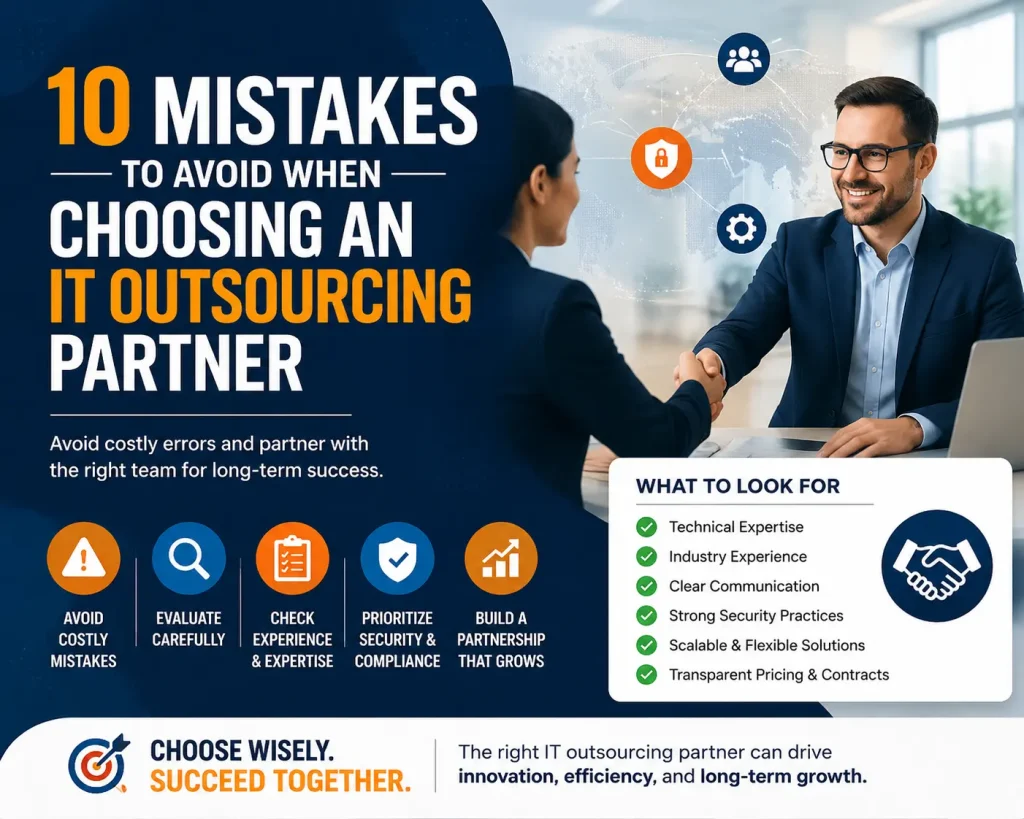
10 Mistakes to Avoid When Choosing an IT Outsourcing Partner
Selecting an IT outsourcing partner is a strategic decision that influences project success, operational efficiency, and long-term business growth. While many providers offer similar services, common evaluation mistakes can lead to missed deadlines, higher costs, security risks, and poor collaboration. Understanding these mistakes helps businesses make informed decisions and build partnerships that deliver lasting value.
The following are the 10 mistakes to avoid when choosing an IT outsourcing partner:
1. Not Defining Clear Project Requirements
Beginning the selection process without clearly defining project objectives, deliverables, timelines, and budgets often leads to confusion and unrealistic expectations. Providers may interpret vague requirements differently, resulting in scope changes, delays, and increased costs. Establishing clear business goals and technical requirements before engaging an outsourcing partner creates a shared understanding and improves project execution.
2. Choosing Based Only on Price
Selecting the lowest-priced provider may reduce short-term expenses but often leads to compromises in quality, communication, technical expertise, and long-term reliability. Instead of focusing solely on cost, evaluate the overall value offered, including experience, service quality, scalability, and ongoing support. A balanced investment often produces better business outcomes than choosing the cheapest option.
3. Ignoring Technical Expertise
Not every outsourcing provider has the technical capabilities required for your project. Failing to assess expertise in relevant programming languages, cloud platforms, cybersecurity, artificial intelligence, or software development methodologies can lead to low-quality deliverables and project delays. Reviewing certifications, technical skills, and previous work helps ensure the provider can successfully meet your requirements.
4. Failing to Verify Past Experience
A provider’s portfolio and client history reveal whether they have successfully delivered similar projects. Skipping this evaluation increases the risk of working with an inexperienced partner who may struggle with your industry’s challenges. Review case studies, testimonials, and client references to verify the quality of delivery, reliability, and experience before making a final decision.
5. Overlooking Communication and Time Zone Differences
Strong communication is essential for successful outsourcing, especially when teams operate across different countries and time zones. Delayed responses, inconsistent updates, and unclear reporting can slow project progress and create misunderstandings. Choose a partner with established communication processes, overlapping working hours when possible, and dedicated project management to maintain effective collaboration.
6. Selecting the Wrong Engagement Model
Different projects require different outsourcing models. Choosing a fixed-price contract for an evolving project or selecting staff augmentation when a dedicated team is needed can reduce flexibility and increase costs. Evaluate whether a fixed-price, time-and-materials, dedicated team, or staff augmentation model best aligns with your project scope, budget, and business objectives.
7. Ignoring Scalability
Business priorities and project requirements often change over time. An outsourcing partner that cannot quickly scale resources, expand technical capabilities, or support increased workloads may slow business growth. Selecting a provider with flexible resource management and access to a larger talent pool helps ensure long-term adaptability as your business evolves.
8. Overlooking Security and Compliance
Sharing sensitive business information with an outsourcing provider requires strong security controls and regulatory compliance. Ignoring data protection practices, compliance certifications, or cybersecurity measures increases the risk of data breaches and legal issues. Verify how the provider manages encryption, access controls, disaster recovery, and compliance with the ISO/IEC 27001 information security management standard before signing an agreement.
9. Skipping Due Diligence
Rushing into an outsourcing agreement without researching the provider can result in poor project performance and unexpected challenges. Conduct due diligence by reviewing the company background, financial stability, customer reviews, technical capabilities, and service agreements. A thorough evaluation helps identify potential risks before they affect your business.
10. Ignoring Cultural Fit
Successful outsourcing depends not only on technical expertise but also on compatible work styles, communication preferences, and business values. Differences in decision-making, collaboration, or workplace culture can create unnecessary friction throughout the project. Choosing a partner whose culture aligns with your organization’s expectations encourages stronger teamwork, smoother communication, and more productive long-term relationships.
Red Flags That Indicate an IT Outsourcing Partner May Not Be Reliable
Not every IT outsourcing provider delivers the expertise, transparency, and reliability your business needs. Recognizing warning signs early helps you avoid costly partnerships, reduce project risks, and choose a provider capable of supporting your long-term objectives. Before signing a contract, evaluate the following red flags, which often indicate that an outsourcing partner may not be dependable.
I. Unrealistically Low Pricing
Pricing that is significantly lower than competitors’ may indicate limited expertise, inexperienced developers, hidden fees, or reduced service quality. While competitive pricing is important, exceptionally low rates often result in poor communication, missed deadlines, or additional costs later in the project. Compare pricing alongside experience, technical capabilities, and overall value, rather than selecting a provider based on cost alone.
II. No Portfolio or Client References
A reputable outsourcing partner should be able to demonstrate previous work through case studies, project portfolios, or client references. Providers that cannot verify their experience may lack the expertise needed for your project or have limited success delivering similar solutions. Reviewing past work helps assess technical capabilities, industry knowledge, and overall reliability before committing.
III. Poor Communication During Sales
The sales process often reflects how communication will continue after the project begins. Slow responses, unclear answers, inconsistent information, or difficulty scheduling meetings may indicate future challenges in collaboration. A reliable provider communicates transparently, responds promptly, and clearly explains project scope, timelines, and expectations from the beginning.
IV. No Security Certifications
An outsourcing provider that cannot demonstrate recognized security standards or compliance practices may expose your business to unnecessary cybersecurity and regulatory risks. Look for evidence of secure development practices, data protection policies, compliance certifications such as ISO 27001 or SOC 2, and documented security procedures. Strong security practices help safeguard sensitive information throughout the partnership.
V. Unclear Contracts or SLAs
A vague contract or poorly defined Service Level Agreement (SLA) often leads to misunderstandings about project scope, responsibilities, timelines, pricing, and performance expectations. Reliable providers offer detailed agreements that clearly define deliverables, support commitments, communication processes, payment terms, and issue resolution procedures. Clear documentation helps protect both parties and establishes accountability throughout the engagement.
Questions to Ask Before Signing an IT Outsourcing Contract
Before signing an IT outsourcing contract, ask questions that clarify the provider’s expertise, project management approach, security practices, pricing, and operational capabilities. These discussions help identify potential risks, set clear expectations, and determine whether the outsourcing partner is equipped to support your business objectives over the long term.
- What Experience Do You Have in Our Industry?
Ask whether the provider has worked with businesses in your industry and completed projects similar to yours. Industry-specific experience means they are more likely to understand your business processes, regulatory requirements, customer expectations, and technical challenges, allowing them to deliver solutions more efficiently.
- Who Will Manage the Project?
Clarify who will serve as your primary point of contact and oversee project execution. Understanding the project management structure, reporting process, and decision-making responsibilities helps ensure accountability, faster issue resolution, and consistent communication throughout the engagement.
- How Do You Protect Data?
Discuss the provider’s approach to cybersecurity, data privacy, and regulatory compliance before sharing sensitive business information. Ask about encryption, access controls, employee security policies, compliance certifications, and incident response procedures to evaluate how well your data will be protected.
- What Happens if Deadlines Are Missed?
Understand how the provider manages project delays and unexpected challenges. Ask whether contracts include service level agreements (SLAs), escalation procedures, revised delivery timelines, or performance guarantees that outline how missed milestones will be handled and communicated.
- How Do You Handle Scaling?
Business requirements often change during a project, making scalability an important consideration. Ask whether the provider can quickly scale up or down the team size, add specialized expertise, or handle larger workloads without disrupting delivery quality or project timelines.
- Which Communication Tools Do You Use?
Effective collaboration depends on clear and consistent communication. Ask which tools the provider uses for messaging, video meetings, project management, documentation, and progress reporting. Familiar collaboration platforms and regular reporting help improve transparency and coordination between teams.
- What Is Included in the Pricing?
Request a detailed breakdown of pricing to understand exactly what services are included. Clarify whether costs cover project management, development, testing, maintenance, support, software licenses, infrastructure, and future changes to avoid unexpected expenses later in the engagement.
- What Is Your Disaster Recovery Process?
Ask how the provider prepares for system failures, cyberattacks, or other business disruptions. A well-defined disaster recovery plan should include data backup procedures, recovery time objectives, business continuity measures, and incident response processes that help minimize downtime and protect critical business operations.
IT Outsourcing Engagement Models Compared
Different IT outsourcing engagement models are designed to support different project requirements, budgets, and management preferences. Choosing the right model depends on factors such as project scope, flexibility, development timeline, and the level of control your business wants to maintain. Understanding the advantages and limitations of each approach helps businesses select an outsourcing model that aligns with their operational and strategic goals.
| Engagement Model | Best For | Advantages | Limitations |
| Dedicated Team | Long-term projects requiring ongoing development and support | Provides a committed team that works exclusively on your projects, offering greater control, deeper business knowledge, and easy scalability. | Higher ongoing costs require active management to maximize productivity. |
| Staff Augmentation | Filling temporary skill gaps or expanding an existing in-house team | Allows businesses to quickly add specialized talent while maintaining full control over project management and workflows. | Internal managers remain responsible for coordinating and supervising the augmented staff. |
| Fixed-Price | Small, well-defined projects with clear requirements and deadlines | Offers predictable costs, defined deliverables, and simplified budgeting with minimal financial uncertainty. | Limited flexibility once development begins, making scope changes more difficult and potentially more expensive. |
| Time and Materials | Projects with evolving requirements or uncertain scope | Provides flexibility to adjust resources, priorities, and project scope as business needs change throughout development. | Final costs are less predictable because pricing depends on the actual time and resources used. |
IT Outsourcing Partner Evaluation Checklist
Choosing an IT outsourcing partner becomes much easier when you follow a structured evaluation checklist instead of relying on price or sales presentations alone. A comprehensive review helps compare providers objectively, identify potential risks, and confirm that each vendor can meet your technical, operational, and business requirements.
Use the checklist below to evaluate every prospective outsourcing partner before making your final decision.
| Evaluation Area | What to Verify | Why It Matters |
| Technical Expertise | Relevant programming languages, cloud platforms, AI capabilities, certifications, and technical skills | Confirms the provider has the expertise to deliver high-quality solutions that match your project requirements. |
| Industry Experience | Case studies, similar projects, and experience within your industry | Demonstrates familiarity with your business challenges, compliance requirements, and operational needs. |
| Track Record | Client testimonials, reviews, references, and project success rates | Helps verify reliability, delivery quality, and long-term customer satisfaction. |
| Security & Compliance | ISO 27001, SOC 2, data protection policies, encryption, and regulatory compliance | Reduces cybersecurity, legal, and operational risks while protecting sensitive business information. |
| Communication | Reporting process, response times, project management approach, and collaboration tools | Supports transparency, faster issue resolution, and effective collaboration throughout the project. |
| Pricing Transparency | Clear pricing structure, including services, contract terms, and potential additional costs.s | Prevents hidden fees and helps compare providers based on overall value rather than price alone. |
| Scalability | Ability to expand or reduce team size and support changing business requirements | Ensures the outsourcing partner can grow alongside your business without disrupting project delivery. |
| Engagement Model | Availability of dedicated teams, staff augmentation, fixed-price, or time-and-materials models | Helps select the engagement model that best fits your project scope, budget, and management preferences. |
| Support & Maintenance | Post-launch support, SLAs, maintenance services, and issue resolution process | Confirms long-term assistance is available after project completion to maintain system performance. |
| Cultural Fit | Work culture, communication style, time zone overlap, and collaboration approach | Promotes stronger teamwork, smoother communication, and a more productive long-term partnership. |
Pro Tip: Before signing any agreement, compare multiple providers using the same evaluation criteria rather than relying on cost alone. A consistent checklist makes it easier to identify the outsourcing partner that offers the best combination of expertise, reliability, scalability, and long-term value.
Benefits of Choosing the Right IT Outsourcing Partner
Selecting the right IT outsourcing partner delivers benefits that extend beyond completing projects on time or reducing operational costs. A reliable provider contributes technical expertise, scalable resources, stronger security practices, and continuous innovation that support long-term business success.
The following benefits demonstrate how the right partnership can improve both day-to-day operations and future growth.
- Better Project Success Rates: Experienced outsourcing partners follow proven development methodologies, maintain clear communication, and apply effective project management practices that improve delivery quality, reduce delays, and increase the likelihood of meeting project objectives.
- Lower Long-Term Costs: Choosing a reliable provider helps reduce costly project rework, hiring expenses, infrastructure investments, and operational inefficiencies. Although the initial investment may be higher, the overall value often results in lower long-term technology costs.
- Faster Product Delivery: Skilled development teams, streamlined workflows, and established processes enable outsourcing partners to complete projects more efficiently. Faster development cycles allow businesses to launch products, features, and updates more quickly while responding to changing market demands.
- Access to Specialized Talent: Outsourcing provides immediate access to experienced software developers, cloud architects, cybersecurity specialists, DevOps engineers, AI experts, and other professionals without the time and expense of recruiting, training, and retaining in-house talent.
- Improved Security and Compliance: Established outsourcing providers implement robust cybersecurity practices, data protection measures, regulatory compliance processes, and disaster recovery plans to protect sensitive business information and reduce operational and legal risks.
- Easier Scalability: Business requirements often change as organizations grow. A dependable outsourcing partner can quickly scale team size up or down, add specialized expertise, and support growing workloads without disrupting project timelines or service quality.
- Stronger Innovation: Leading IT outsourcing providers introduce emerging technologies, modern development practices, and industry best practices that help businesses improve operational efficiency, modernize existing systems, and remain competitive in an evolving technology landscape.
FAQs
What Should I Look for in an IT Outsourcing Company?
Look for an IT outsourcing company with proven technical expertise, relevant industry experience, transparent pricing, strong security practices, effective communication, scalable resources, positive client references, and a delivery model that aligns with your business objectives.
What Are the Biggest Risks of IT Outsourcing?
The biggest risks include poor communication, project delays, data security breaches, hidden costs, quality issues, compliance failures, and choosing a provider that lacks the technical expertise or resources to meet your requirements.
Which IT Outsourcing Model Is Best?
The best IT outsourcing model depends on your project scope and business needs. Dedicated teams are ideal for long-term projects, staff augmentation works well for filling skill gaps, fixed-price suits projects with clear requirements, and time-and-materials offers flexibility for evolving projects.
How Much Does IT Outsourcing Cost?
IT outsourcing costs vary based on project complexity, required expertise, location, engagement model, and contract duration. Businesses should compare providers based on overall value, service quality, and long-term cost efficiency rather than hourly rates alone.
What Should Be Included in an Outsourcing Contract?
An outsourcing contract should clearly define the project scope, deliverables, timelines, pricing, payment terms, service-level agreements (SLAs), security requirements, intellectual property ownership, confidentiality obligations, and dispute-resolution procedures.
How Do I Evaluate an Outsourcing Provider’s Security?
Review the provider’s cybersecurity policies, data encryption methods, access controls, compliance certifications, disaster recovery plans, incident response procedures, and security monitoring practices to ensure sensitive business information is properly protected.
What Certifications Should an IT Outsourcing Partner Have?
Depending on the services provided, reputable IT outsourcing partners commonly hold certifications such as ISO 27001 for information security management, SOC 2 for security and data protection controls, ISO 9001 for quality management, and cloud certifications from providers such as AWS, Microsoft Azure, or Google Cloud, demonstrating technical expertise.