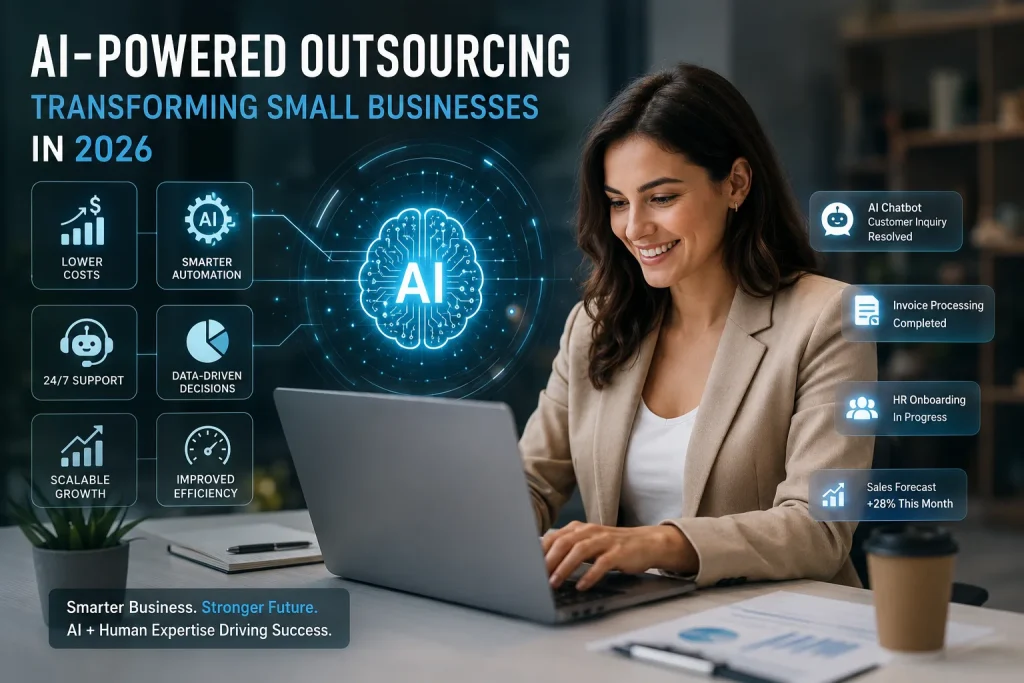
Artificial intelligence is redefining outsourcing by combining intelligent automation with human expertise to help small businesses operate faster, smarter, and more efficiently. AI-powered outsourcing leverages technologies such as machine learning, generative AI, and robotic process automation (RPA) to streamline repetitive tasks, improve decision-making, and reduce operational costs, enabling employees to focus on higher-value work.
From customer service and finance to HR, marketing, and IT, businesses are adopting AI outsourcing to increase productivity, strengthen customer experiences, and build scalable operations that remain competitive in an increasingly digital business environment.
Key Highlights
- AI-powered outsourcing combines artificial intelligence with outsourced expertise to automate repetitive business processes while improving speed, accuracy, and scalability.
- Small businesses are adopting AI outsourcing to lower costs, improve productivity, strengthen customer support, and overcome resource constraints.
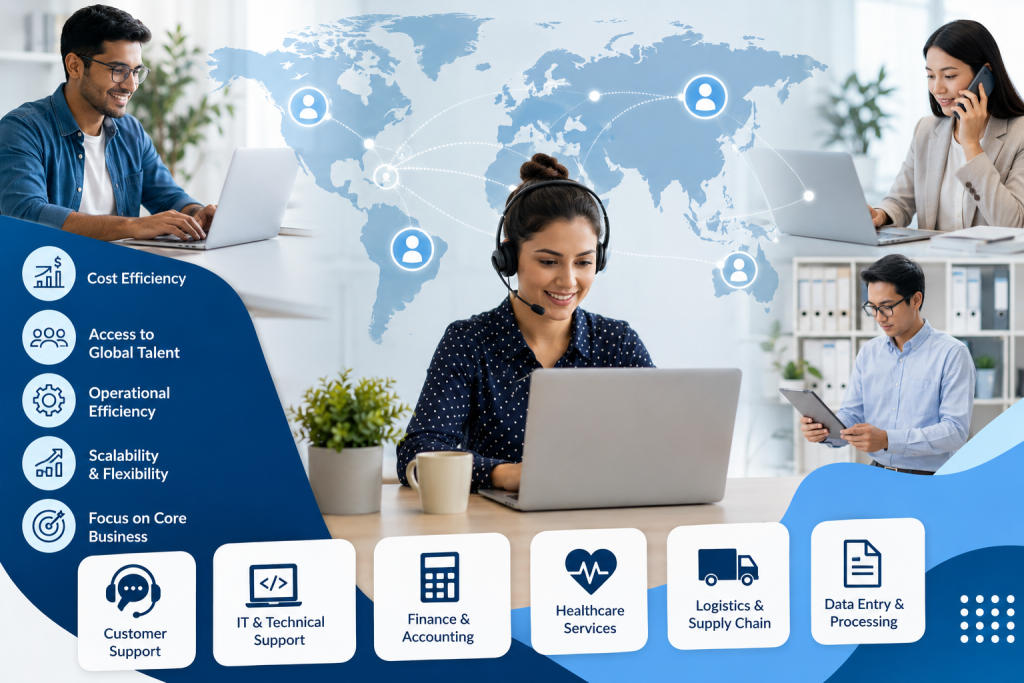
- Customer service, finance, HR, marketing, IT, cybersecurity, and document processing are among the business functions benefiting most from AI-powered outsourcing.
- Successful adoption depends on choosing the right provider, integrating AI with existing workflows, training employees, and continuously optimizing performance.
- Emerging trends such as AI agents, hyperautomation, predictive analytics, and human-AI collaboration will continue reshaping outsourcing beyond 2026.
What Is AI-Powered Outsourcing?
AI-powered outsourcing is the use of artificial intelligence technologies, such as machine learning, generative AI, and robotic process automation (RPA), to automate, enhance, and optimize outsourced business services. Unlike traditional outsourcing, which relies primarily on human labor, it combines AI with human expertise to complete repetitive tasks more quickly, improve accuracy, and support better decision-making. At the same time, people handle complex work and customer interactions.
In 2026, technologies including generative AI, machine learning, RPA, natural language processing, computer vision, and predictive analytics are driving adoption across customer service, finance, HR, IT, marketing, and other business functions to reduce costs, improve productivity, and scale operations more efficiently.
Why Are Small Businesses Adopting AI Outsourcing Faster Than Ever?
Small businesses are rapidly adopting AI-powered outsourcing to reduce operational costs, address talent shortages, deliver 24/7 customer support, and automate repetitive tasks without requiring significant in-house resources. By combining artificial intelligence with outsourced expertise, businesses can streamline processes such as customer service, bookkeeping, marketing, and data management while improving accuracy, scalability, and productivity. Cloud-based AI solutions have also made advanced technologies more affordable, allowing startups and SMBs to access specialized capabilities without large infrastructure investments.
As customer expectations rise and competition intensifies, AI outsourcing enables businesses to optimize workflows, respond faster to market demands, and focus internal teams on strategic, revenue-generating activities. Understanding why businesses are embracing AI outsourcing is only part of the picture. The next explores the seven practical ways AI-powered outsourcing is transforming small businesses in 2026, from reducing costs to improving customer experiences and enabling scalable growth.
7 Ways AI-Powered Outsourcing Is Transforming Small Businesses
AI-powered outsourcing is reshaping how small businesses operate by combining intelligent automation with outsourced expertise. Unlike traditional outsourcing, AI outsourcing services use technologies such as machine learning, natural language processing (NLP), and predictive analytics to improve efficiency, reduce manual effort, and support data-driven decision-making.
Below are seven key ways AI-powered business outsourcing is transforming small businesses in 2026.
1. Lower Operational Costs
Managing operational expenses remains a significant challenge for small businesses. AI outsourcing helps reduce costs by automating repetitive tasks such as invoice processing, payroll management, appointment scheduling, and document handling. Businesses can minimize manual workloads, reduce administrative overhead, and avoid the expense of hiring large in-house teams. For example, AI outsourcing services can automatically process invoices and reconcile financial records, allowing employees to focus on strategic initiatives instead of routine administrative work.
2. Deliver Faster and Smarter Customer Support
Customers expect quick, accurate responses across multiple communication channels. AI-powered business outsourcing enables businesses to provide 24/7 customer support through AI chatbots, virtual assistants, and automated ticket routing. These solutions can answer common questions, track orders, schedule appointments, and escalate complex issues to human agents when necessary. As a result, businesses improve response times, increase customer satisfaction, and reduce support costs without expanding their customer service teams.
3. Improve Decision-Making with Data Analytics
Modern businesses generate large volumes of operational and customer data every day. Outsourced AI solutions help convert this data into actionable insights by identifying trends, forecasting demand, and monitoring business performance. AI-powered analytics can evaluate customer behavior, sales patterns, and marketing performance in real time, allowing business owners to make informed decisions faster. This data-driven approach reduces uncertainty and supports long-term business growth.
4. Automate Back-Office Operations
Routine administrative work often consumes valuable employee time. AI-powered outsourcing streamlines back-office functions such as bookkeeping, HR administration, data entry, document verification, and compliance reporting. Intelligent automation reduces manual errors while accelerating workflows across multiple departments. Businesses can maintain greater operational consistency without increasing their workforce, making AI business automation an effective solution for growing organizations.
5. Strengthen Marketing and Sales Performance
Marketing teams increasingly rely on AI for small businesses to improve campaign performance and customer engagement. AI-powered outsourcing providers can analyze customer behavior, identify high-value leads, personalize email campaigns, generate content recommendations, and optimize advertising strategies. These capabilities allow businesses to target the right audience more effectively while reducing the time spent on manual campaign management. Sales teams also benefit from AI-driven lead scoring and automated follow-up workflows that improve conversion opportunities.
6. Improve Security and Risk Management
Cybersecurity threats continue to evolve, making proactive monitoring essential for businesses of every size. AI outsourcing services can continuously monitor networks, detect unusual activity, identify potential vulnerabilities, and automate threat detection before incidents escalate. AI also supports fraud detection by analyzing transaction patterns and identifying anomalies that may indicate suspicious activity, strengthening overall risk management efforts. This proactive approach helps businesses improve security while reducing the workload on internal IT teams.
7. Scale Business Operations with Greater Flexibility
One of the greatest advantages of AI-powered outsourcing for small businesses is its ability to scale alongside business growth. Whether a company experiences seasonal demand, expands into new markets, or launches additional products, AI-enabled outsourcing solutions can quickly adapt without requiring major infrastructure investments or large recruitment efforts. Businesses gain access to specialized expertise, intelligent automation, and scalable resources that support sustainable growth while maintaining operational efficiency.
Business Functions That Can Be AI-Outsourced
Not every business process requires human intervention from start to finish. AI-powered outsourcing allows small businesses to automate repetitive, data-intensive, and customer-facing tasks while improving efficiency and reducing operational costs. By integrating AI outsourcing services into core business functions, organizations can optimize workflows, improve accuracy, and enable employees to focus on strategic initiatives.
Here are the key business functions that benefit the most from outsourcing with artificial intelligence.
I. Customer Support
One of the most widely adopted applications of AI-powered business outsourcing is customer support. AI chatbots, virtual assistants, and intelligent ticketing systems can handle frequently asked questions, process service requests, provide order updates, and route complex issues to human agents. This approach delivers faster response times, consistent customer experiences, and round-the-clock support without significantly increasing staffing costs.
II. Bookkeeping and Financial Operations
Financial management involves repetitive tasks such as invoice processing, expense categorization, payroll assistance, and financial reporting. AI business automation can process invoices, reconcile transactions, identify anomalies, and generate financial summaries with minimal manual effort. Businesses gain greater accuracy, reduce administrative workloads, and improve financial visibility while maintaining compliance with accounting standards.
III. Human Resources and Recruitment
Hiring and employee management require substantial administrative effort. Outsourced AI solutions can screen resumes, rank candidates based on predefined criteria, schedule interviews, answer employee queries, and automate onboarding documentation. HR teams spend less time on repetitive administrative work and more time evaluating talent, improving employee engagement, and supporting workforce development.
IV. Marketing and Content Creation
Marketing teams increasingly rely on AI for small businesses to improve campaign performance and audience engagement. AI-powered outsourcing providers can conduct keyword research, analyze customer behavior, generate content ideas, optimize email campaigns, and monitor advertising performance. These capabilities help businesses create more personalized marketing strategies while reducing the time required for manual campaign management.
V. Sales and Lead Management
AI-powered outsourcing enhances sales operations by automating lead qualification, customer segmentation, follow-up reminders, and CRM updates. Intelligent systems analyze customer interactions to identify high-potential prospects, allowing sales teams to prioritize opportunities with the greatest conversion potential. This improves sales productivity while creating a more efficient customer acquisition process.
VI. IT Support and Cybersecurity
Managing technology infrastructure and cybersecurity can be resource-intensive for small businesses. AI outsourcing services can continuously monitor systems, detect unusual activity, automate routine maintenance, and identify potential security threats before they escalate. AI-powered monitoring improves system reliability, strengthens data protection, and reduces the burden on internal IT teams.
VII. Data Entry and Document Processing
Administrative tasks involving data entry and document management are ideal candidates for AI-powered outsourcing. Intelligent document processing solutions can extract information from invoices, contracts, forms, and receipts, reducing manual input while improving speed and accuracy. Businesses benefit from streamlined workflows, fewer processing errors, and quicker access to business-critical information.
Knowing which business functions can be AI-outsourced provides a practical starting point, but seeing these solutions in action offers even greater clarity. Now that you know which business functions can benefit from AI-powered outsourcing, let’s examine how these solutions are being applied in real-world scenarios to improve efficiency, reduce costs, and support business growth.
Real-World Examples of AI Outsourcing
Businesses across industries are using AI-powered outsourcing to automate repetitive tasks, improve service quality, and make faster decisions. By combining human expertise with intelligent automation, AI outsourcing services help small businesses optimize operations without investing heavily in in-house resources. Here are a few practical examples of how outsourcing with artificial intelligence is delivering measurable business value.
A. AI Customer Support
Many e-commerce stores and service providers use AI chatbots to answer frequently asked questions, track orders, and schedule appointments. While AI handles routine inquiries, human agents focus on complex customer issues, reducing response times and improving customer satisfaction.
B. AI Accounting and Bookkeeping
Small businesses increasingly rely on AI-powered business outsourcing for invoice processing, expense categorization, payroll support, and financial reporting. AI automatically extracts financial data, detects inconsistencies, and generates reports, allowing finance teams to improve accuracy while reducing manual workloads.
C. AI Marketing Automation
Marketing agencies use AI for small businesses to analyze customer behavior, identify high-performing keywords, personalize email campaigns, and optimize digital advertising. These insights help businesses improve campaign performance while minimizing the time spent on repetitive marketing tasks.
D. AI-Powered IT and Cybersecurity
Managed IT providers integrate AI to monitor networks, identify unusual activity, automate system maintenance, and detect potential cybersecurity threats. This proactive approach strengthens security while helping businesses maintain reliable technology infrastructure with fewer internal resources.
E. AI Document and Data Processing
Organizations handling large volumes of documents use outsourced AI solutions to automate data extraction from invoices, contracts, forms, and receipts. Intelligent document processing reduces manual data entry, accelerates workflows, and improves overall operational efficiency.
Benefits of AI-Powered Outsourcing
The growing adoption of AI outsourcing reflects the measurable value it delivers across business operations. By combining automation with specialized expertise, businesses can improve efficiency, reduce costs, and build more scalable processes.
- Reduced operational costs: AI-powered outsourcing automates repetitive, time-consuming tasks such as data entry, invoice processing, scheduling, and customer support, helping businesses lower labor costs, reduce administrative overhead, and allocate resources more efficiently.
- Improved productivity: By handling routine operational tasks, AI enables employees to focus on high-value activities such as business strategy, customer relationship management, innovation, and revenue generation, resulting in greater overall productivity.
- Greater accuracy: AI systems minimize human errors in processes such as financial reporting, document processing, inventory management, and data analysis by following consistent workflows and validating information with greater precision.
- Faster decision-making: AI analyzes large volumes of business data in real time to identify trends, forecast outcomes, and generate actionable insights, allowing business owners to make informed decisions quickly and respond proactively to changing market conditions.
- Enhanced customer experience: AI-powered customer support tools, including chatbots and virtual assistants, provide instant responses, personalized recommendations, and round-the-clock assistance, helping businesses improve customer satisfaction and build stronger long-term relationships.
- Better scalability: AI-powered business outsourcing enables organizations to manage growing workloads, seasonal demand, and business expansion without a proportional increase in staffing, infrastructure, or operational costs, making growth more sustainable.
- Access to specialized expertise: AI outsourcing services provide businesses with access to advanced technologies, industry-specific knowledge, and skilled professionals without the time and expense of recruiting, training, and maintaining specialized in-house teams.
- Competitive advantage: Businesses that adopt AI-powered outsourcing can streamline operations, improve efficiency, accelerate innovation, and adapt more quickly to changing customer expectations and market trends, positioning themselves ahead of competitors in an increasingly digital economy.
While the benefits of AI-powered outsourcing are compelling, successful implementation also requires understanding its potential limitations. The next section examines the key challenges, risks, and considerations businesses should evaluate before adopting AI-driven outsourcing solutions.
Challenges of AI-Powered Outsourcing
While AI-powered outsourcing offers significant advantages, businesses should carefully evaluate potential challenges before implementation. Addressing these considerations early helps organizations maximize the value of AI outsourcing services while minimizing operational and compliance risks.
1. Data Privacy and Security
AI-powered outsourcing often involves processing sensitive customer, financial, and operational data. Without robust security measures, businesses may face risks related to data breaches, unauthorized access, or regulatory non-compliance. Choosing outsourcing partners with strong cybersecurity practices, encryption protocols, and compliance certifications is essential for protecting business information.
2. Integration with Existing Systems
Integrating AI solutions into existing business processes and software can be complex, particularly for organizations using legacy systems. Compatibility issues, data migration challenges, and workflow disruptions may delay implementation. Businesses should assess their current technology infrastructure and work with providers that offer seamless integration and ongoing technical support.
3. Limited Human Judgment
Although AI excels at automating repetitive tasks and analyzing large datasets, it cannot fully replicate human creativity, critical thinking, or emotional intelligence. Customer negotiations, strategic planning, and complex problem-solving still require human expertise. Businesses achieve the best results by combining AI automation with skilled professionals rather than relying solely on intelligent systems.
4. Employee Adaptation and Skill Development
Introducing AI-powered workflows may require employees to adapt to new tools and responsibilities. Resistance to change or insufficient training can reduce adoption rates and impact productivity. Providing adequate training and communicating how AI supports employees rather than replaces them helps create a smoother transition.
5. Vendor Selection and Reliability
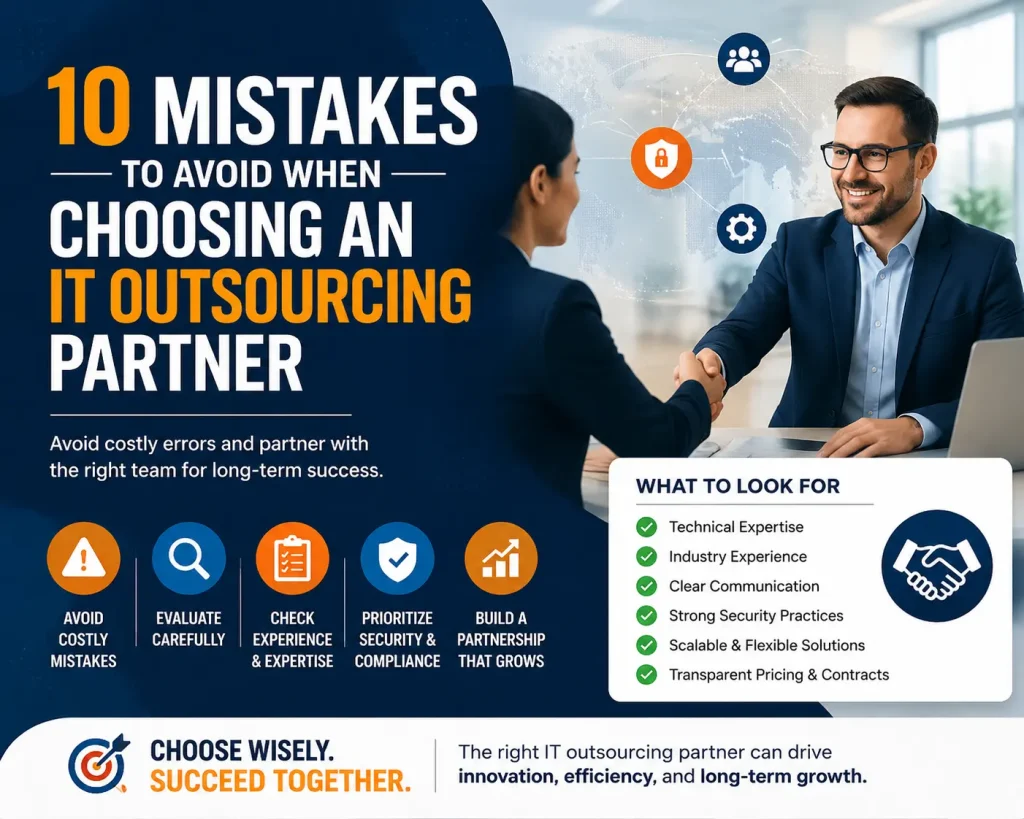
The success of AI-powered business outsourcing largely depends on selecting the right service provider. Businesses should evaluate vendors based on their technical expertise, industry experience, security standards, scalability, and customer support. A reliable outsourcing partner should align with both current business needs and future growth objectives.
AI Outsourcing vs. Traditional Outsourcing
Although both approaches help businesses reduce operational workloads, AI outsourcing introduces intelligent automation that improves speed, consistency, and scalability beyond what traditional outsourcing typically offers.
| Feature | AI-Powered Outsourcing | Traditional Outsourcing |
| Task Execution | Combines AI automation with human expertise to efficiently complete repetitive, data-driven tasks. | Relies primarily on human professionals to perform assigned tasks manually. |
| Speed | Processes high-volume tasks in real time with minimal delays. | Processing speed depends on workforce availability and manual effort. |
| Accuracy | Uses machine learning and automation to reduce repetitive human errors. | Accuracy depends largely on employee experience and quality control processes. |
| Scalability | Easily adapts to changing workloads without significant increases in staffing. | Scaling operations often requires hiring and training additional personnel. |
| Cost Efficiency | Reduces long-term operational costs by automating routine processes. | Labor costs typically increase as business operations expand. |
| Availability | AI-powered tools can operate continuously, providing 24/7 support and monitoring. | Service availability depends on business hours, staffing levels, or contractual arrangements. |
| Best Use Cases | Customer support, data processing, marketing automation, finance, IT monitoring, and workflow automation. | Specialized consulting, creative services, strategic decision-making, and relationship-driven business functions. |
Rather than replacing traditional outsourcing entirely, outsourcing with artificial intelligence complements human expertise by automating repetitive processes while allowing professionals to focus on complex, strategic, and customer-centric work. For many small businesses, a hybrid approach delivers the ideal balance of efficiency, flexibility, and expertise.
Understanding both the benefits and challenges of AI-powered outsourcing helps businesses make informed decisions. The next outlines a practical step-by-step approach to implementing AI outsourcing and explores the emerging trends that will shape its future beyond 2026.
How to Successfully Implement AI-Powered Outsourcing
Adopting AI-powered outsourcing requires a structured approach that aligns technology with business objectives. Rather than automating every process at once, businesses should identify high-impact opportunities, select the right AI outsourcing services, and continuously measure performance to maximize long-term value.
Follow these Steps to successfully implement AI-Powered Outsourcing:
Step 1: Identify Repetitive and Time-Consuming Tasks
Start by evaluating daily operations to identify processes that consume significant time and resources. Tasks such as customer support, data entry, bookkeeping, appointment scheduling, and document processing are often ideal candidates for AI business automation because they follow predictable workflows and require minimal human judgment.
Step 2: Choose the Right AI Outsourcing Partner
Selecting a reliable provider is critical to the success of AI-powered business outsourcing. Evaluate potential partners based on their industry expertise, AI capabilities, security standards, integration support, scalability, and customer service. A trusted provider should understand your business requirements and deliver solutions that align with your operational goals.
Step 3: Integrate AI with Existing Workflows
Successful implementation depends on seamless integration with your existing systems, including CRM platforms, accounting software, communication tools, and ERP solutions. Proper integration enables AI to automate workflows without disrupting daily operations while ensuring consistent data flow across departments.
Step 4: Train Employees and Monitor Performance
Introducing AI should complement your workforce rather than replace it. Provide employees with the training needed to work alongside AI-powered tools and establish key performance indicators (KPIs) to measure success. Metrics such as response times, cost savings, productivity improvements, customer satisfaction, and error reduction help evaluate the effectiveness of your AI outsourcing strategy.
Step 5: Continuously Optimize AI Processes
AI systems improve through continuous learning and refinement. Regularly review workflows, analyze performance data, and update automation rules to adapt to changing business needs. Ongoing optimization ensures outsourced AI solutions remain accurate, efficient, and aligned with organizational objectives as your business grows.
Future Trends in AI-Powered Outsourcing
As artificial intelligence continues to evolve, AI-powered outsourcing for small businesses will become more intelligent, autonomous, and deeply integrated into everyday operations. Several emerging trends are expected to shape the future of outsourcing with artificial intelligence beyond 2026.
Here are some of the Future Trends in AI-Powered Outsourcing:
- AI Agents Will Handle Complex Business Processes
Autonomous AI agents are evolving beyond simple task automation. Future AI systems will manage multi-step workflows, coordinate projects, schedule meetings, analyze business data, and make routine operational decisions with minimal human intervention, allowing businesses to operate more efficiently.
- Hyperautomation Will Expand Across Departments
Businesses will increasingly combine AI, robotic process automation (RPA), machine learning, and workflow orchestration to automate end-to-end business processes. This trend will enable organizations to eliminate repetitive manual tasks across finance, HR, customer service, supply chain management, and administrative operations.
- Predictive Analytics Will Drive Smarter Decisions
Advanced predictive analytics will help businesses anticipate customer demand, identify operational risks, optimize inventory levels, and forecast financial performance more accurately. These AI-driven insights will support proactive decision-making rather than reactive problem-solving.
- Human-AI Collaboration Will Become the Standard
Rather than replacing employees, AI will continue to support human expertise by handling repetitive and data-intensive tasks. Professionals will focus on strategic planning, creativity, relationship management, and complex decision-making, while AI handles routine operational tasks. This collaborative approach will improve productivity while preserving the value of human judgment.
- Industry-Specific AI Solutions Will Accelerate Adoption
AI outsourcing providers are increasingly developing specialized solutions tailored to industries such as healthcare, retail, finance, legal services, manufacturing, and logistics. These customized platforms will allow businesses to implement AI more quickly while addressing industry-specific compliance requirements and operational challenges.
As AI-powered outsourcing continues to reshape business operations, many organizations still have questions about its implementation, costs, and long-term value. The following FAQs address the most common concerns to help you make informed decisions about adopting AI-driven outsourcing solutions.
Is AI-Powered Outsourcing Right for Your Small Business?
AI-powered outsourcing is a practical choice for small businesses that want to reduce administrative work, improve operational efficiency, and scale without significantly increasing headcount. It delivers the greatest value when repetitive, time-consuming tasks limit productivity or when internal teams lack the resources to manage growing workloads. Before investing, evaluate whether your business processes, goals, and budget align with the technology’s capabilities and long-term benefits.
1. Businesses That Benefit the Most
Small businesses with repetitive administrative processes, limited in-house resources, growing customer demand, or plans to scale operations typically benefit the most from AI-powered outsourcing. Companies that handle large volumes of customer inquiries, financial transactions, HR administration, data processing, or marketing activities often achieve greater efficiency, lower operating costs, faster response times, and improved accuracy by combining AI tools with outsourced expertise.
2. Industries Seeing Rapid Adoption
AI-powered outsourcing is being adopted rapidly across industries such as customer service, healthcare, finance, e-commerce, retail, manufacturing, logistics, human resources, marketing, and IT services. These sectors use AI to automate repetitive workflows, improve data analysis, strengthen customer support, streamline administrative operations, and increase overall productivity while allowing employees to focus on higher-value strategic work.
Key Questions Before Investing
Before investing in AI-powered outsourcing, ask yourself:
- Which repetitive business processes consume the most time?
- Will AI improve efficiency without reducing service quality?
- Can the outsourcing provider integrate with your existing systems?
- How will customer and business data be protected?
- What are the total implementation and ongoing costs?
- What return on investment (ROI) do you expect?
- Can the solution scale as your business grows?
- Will employees require training to work effectively with AI-powered tools?
FAQs
Is AI outsourcing expensive?
AI outsourcing can be cost-effective because businesses pay for the services they need, reducing labor costs, manual work, and operational inefficiencies.
Can AI replace traditional outsourcing?
No. AI is transforming outsourcing rather than completely replacing it.
Which industries benefit the most?
Healthcare & Medical Services, Information Technology & AI, and Finance & Insurance are among the industries benefiting the most from AI-powered outsourcing.
Is AI outsourcing secure?
Yes, when providers use strong cybersecurity measures, data encryption, access controls, regulatory compliance, and clear data governance practices.
How do I choose an AI outsourcing provider?
Choose a provider with relevant industry experience, proven AI capabilities, strong security standards, transparent pricing, integration support, and reliable customer service.