
If you’re a small business owner, you know this feeling. You sit down at your computer, ready to tackle some important tasks for your business. Hours pass, and you’re still buried in your email inbox, rescheduling a meeting, and updating a spreadsheet that probably should have been automated three months ago.
This is life for most business owners and entrepreneurs today. They’re taking on too many responsibilities, and their most valuable time is quietly being eaten away by mundane tasks. These works could be addressed by others. That said, hiring a full-time in-house assistant is just too expensive, too time-consuming, and just too impractical for most small to medium-sized businesses.
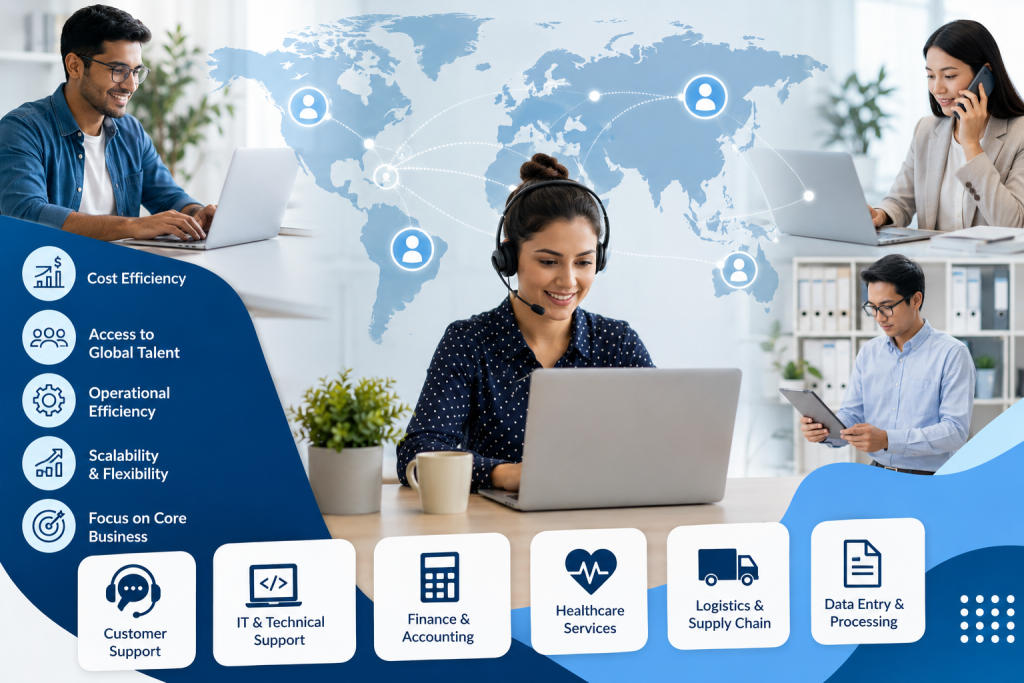
That’s why small businesses are making a definitive shift in 2026: outsourced personal virtual assistants. In this blog, we are going to explore exactly why this is happening and what benefits this trend is providing small businesses. Moreover, we will also understand how to make this model successful for your business from day one.
The Growing Administrative Burden on Small Business Owners
Administrative tasks are not typically included in the business owner’s strategic plan. However, they inevitably take up a disproportionate amount of their time. The irony, as mentioned earlier, is that these tasks are indeed important, just not for the business owner to handle. Let’s take a look at some of the operational costs that these works include:
- Scheduling meetings across multiple time zones.
- Tackling the problem of several emails and responding to basic questions.
- Researching vendors, flights, and stays for business trips.
- Preparing documents, building reports, and organizing information.
- Following up with clients and updating the CRM.
- Coordinating between teams or contractors for recurring tasks.
All this time spent on these tasks comes with an opportunity cost for sales, partnerships, product development, or strategy. The cost is both monetary and non monetary, but the overall cost that is felt when leadership time is spent on the wrong issues.
Why Small Businesses Are Choosing Outsourced Personal Virtual Assistants in 2026
The trend towards remote and flexible support options has been building for years. However, in 2026, it’s simply the new normal for smart and growing businesses. What was once a hack for cash-strapped startups is now a strategic decision made by founders, executives, and leaders who recognize that support is a growth driver, not just an expense line.
The reasons why businesses are making this shift are driven by real cost constraints, real talent dynamics, and the very real challenge of keeping a lean team’s priorities straight. Here’s what’s behind it.
1. Rising Costs of Local Hiring
According to ddiy.co, “Hiring a virtual assistant can decrease company costs by up to 78% compared to full-time in-house staff.”
A full-time in-house personal assistant is a much more expensive proposition than the starting salary alone would indicate. When you factor in employer taxes, benefits, paid time off, equipment, office space, and training time in expensive markets like the USA, the actual annual cost of a single administrative hire can quickly escalate to $60,000 to $80,000 or more. This depends on the industry and location, for a position that may not necessarily require 40 hours of productive work per week.
Then, of course, there is the actual HR overhead of managing an employee, including performance evaluations, payroll processing, sick leave, and other compliance issues. All of these adds yet another layer of management complexity to an already lean team. With outsourced personal VA assistance, businesses only pay for the support they actually require. No benefits, no fixed headcount costs, and no severance package if priorities change.
Whether it is 10 hours of support per week or full-time support, the engagement scales to meet the actual workload requirements, making it one of the most frugal support options available to small businesses today.
2. Access to Skilled Support Without Full-Time Commitment
Outsourced does not necessarily mean unskilled. Experienced and skilled personal virtual assistants, working through a reputable outsourcing service, have likely worked with numerous businesses in various industries, have adjusted to numerous workflows, and have gained actual administrative skills, often more than a fresh in-house employee.
When you hire an outsourced personal virtual assistants through a reputable provider, you’re not just hiring someone to help you with your tasks. You’re hiring someone who has already overcome the same operational challenges that your business is currently facing. They have already learned to manage your emails, schedule your appointments, and track your tasks. They have already learned to overcome the same challenges that your in-house team is currently trying to overcome.
But perhaps most importantly, you’re not committing to a long-term employment contract. If your needs change, your support can change without the expense and difficulty of terminating an employment contract. For small businesses that need to change quickly, that’s just as valuable as the service itself.
3. More Time for High-Value Work
Business owners and founders, think of your most recent full week of work. How many hours have you spent on emails, scheduling, data entry, or other basic coordination efforts that could have been handled by a skilled VA? We can agree that for most founders or executives, this is more than they’d care to admit.
These are hours that could have been spent on closing more deals, building client relationships, or driving the business decisions that will take their companies to the next level. By offloading your personal assistant duties to a skilled VA, you’re able to hit the ground running every day, knowing your inbox is handled, your schedule is optimized, and the background noise is gone.
4. Flexible and Scalable Support
One of the best tangible benefits of outsourcing personal assistant support is that it can be scaled up or down in direct proportion to your business needs. This flexibility comes without having to go through the process of hiring someone new every time your business needs change. You may need to start at a rate of 10 to 15 hours per week. This time is more than enough to cover calendar management, email triaging, and a few other tasks.
As your business grows and your operational needs become more complex, scaling up your support can be done in a straightforward way, without having to go through the process of hiring someone new. And when your business slows down or goes through a transition that reduces your operational needs, scaling back can also be done. On top of that, you can do this without having to have that difficult conversation about reducing someone’s hours.
This type of scalability in both directions is something that cannot be duplicated by having someone full-time. Moreover, it ensures that your business remains right-sized operationally, without ever overpaying for someone’s time when you don’t need it.
5. Support Across Time Zones
A local in-house assistant is only available during your own business hours. If your business has clients, suppliers, or partners in various time zones, this is a significant limitation. Anything that is overnight will simply have to wait until morning. With outsourced remote personal assistant services, this is no longer the case.
Depending on your outsourced remote personal assistant’s location, support services could be available even when your local team is unavailable. This is particularly important if your business has clients in various time zones. Even if your business is in a single market, this time zone offset is important.
If you’re assigning tasks at the end of the day, they’re completed overnight and ready for your review in the morning. You come in each morning ready to progress, not with a list of overnight tasks. This is one of the unsung benefits of outsourced remote personal assistant services.
6. Improved Organization and Productivity
Operational chaos creeps up on businesses as missed follow-ups, double-booked meetings, buried emails, and tasks that everyone assumed someone else was handling. The problem lies with the fact that no systems are being built within the business, as everyone is too busy executing to build those systems.
The skilled virtual assistant for small business owners does not simply provide task completion. They provide processes. When the virtual assistant owns the calendar, the inbox, the CRM, and the processes, they will inevitably provide processes to areas of the business that were previously running in chaos.
This, of course, has a direct impact on the small business owner and the executive team. For instance, there are fewer fires to fight and fewer decisions to make as a result of disorganized information.
7. Access to Modern Tools and Digital Workflows
One of the first questions people ask about bringing on a new VA is how quickly they will get up to speed on your systems. With experienced outsourced personal VAs, this is rarely a significant issue. They’re familiar with CRM systems such as HubSpot or Salesforce, project management systems such as Asana or ClickUp, document systems such as Google Workspace, and communication systems.
They’re familiar with many systems across many clients. This is important, as one thing that in-house people often lack is a “reality check” on how systems should be set up. They know what good looks like.
Good outsourced personal virtual assistants know what a good pipeline, a good calendar, and a good inbox looks like. They know how to use systems to get results. Experienced remote VAs are also comfortable working in asynchronous environments. They know how to document their work, know how to flag issues, and know how to keep their task status visible. They’re able to get up to speed quickly and get to work on how to improve your systems, not just how to use your systems.
Also Read: Why Every Startup Needs a Social Media Virtual Assistant?
Tasks Small Businesses Commonly Outsource to Personal VAs
If you’re curious what kinds of tasks are actually worth outsourcing, the answer is: the answer is most of them. The following are what small businesses and entrepreneurs typically look to outsource to an outsourced personal VA:
- Management of email inbox
- Management of the calendar
- Business travel research and planning
- Data entry
- Research projects and report writing
- Updates to the CRM
- Formatting documents
- Client follow-ups
- Expense tracking
- Meeting preparation, note-taking, and follow-through on action items taken at the meeting
Read More: How Virtual Assistants Save 20+ Hours a Week for CEO?
The Bottomline
Administrative overload doesn’t come with a warning sign, it simply works in the background. Administrating overload quietly eroding the time and attention you should be focusing on growing your business. By the time most entrepreneurs realize what’s happening, they’ve already sacrificed months of strategic momentum to tasks that could have been delegated.
Outsourced personal virtual assistants can transform small businesses who are looking to get that time back, without the expense, hassle, and risk associated with hiring fulltime employees locally. They offer expert-level administrative expertise, familiarity with business software, and the scalability to match your business growth rather than limit it.
Ready to take back control of your time? See how personal VA services from Global Teams AI can help with your business operations, and learn how quickly a personal VA can be integrated into your workflow. Contact GTeams AI today to get the best assistants for your business.